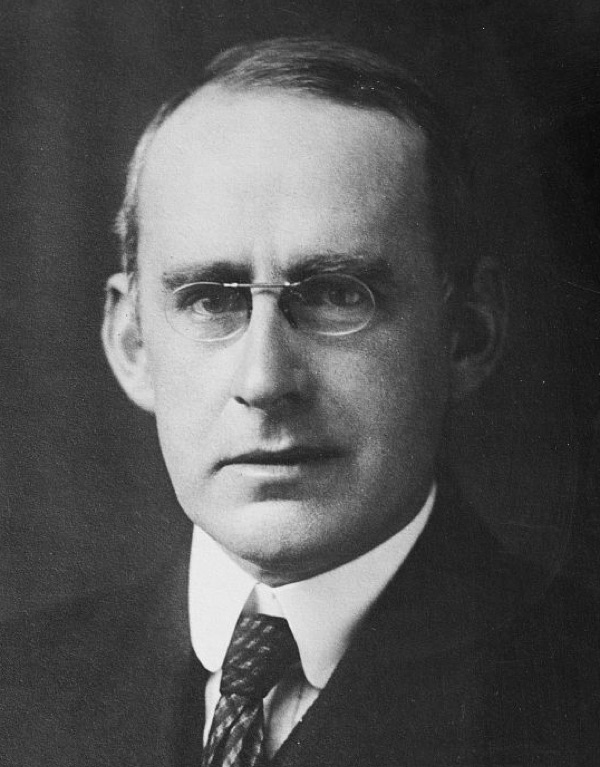
 George Grantham Bain Collection, Library of Congress Prints and Photog · Public domain
Astrophysics · 1882-1944
Arthur Eddington
Proving Einstein right and explaining how stars shine
The story
Eddington led the 1919 eclipse expeditions that measured starlight bending around the Sun, catapulting general relativity (and Einstein) to world fame. He then built the physics of stellar interiors, showing stars balance gravity against radiation and proposing — before anyone believed it — that they burn by fusing hydrogen.
Why it matters
He created stellar astrophysics as a discipline and set the template for testing bold theory with expedition data. The Eddington limit — the brightness ceiling for stars and feeding black holes — carries his name.
The deep dive
Researched for the Atlas from Wikipedia — Arthur Eddington (32,301 characters read) · updated Sep 20, 2026
01 A Quaker childhood and the road to Cambridge
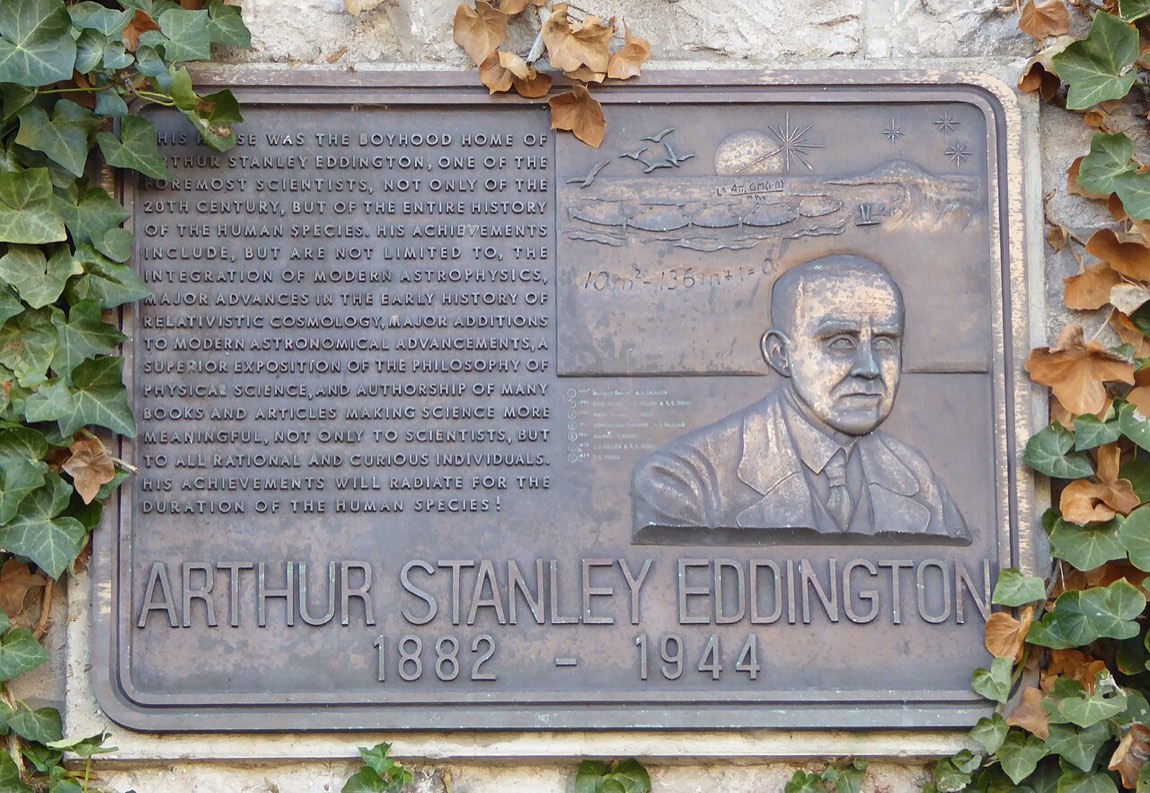
Arthur Stanley Eddington was born on 28 December 1882 in Kendal, Westmorland — now Cumbria — into a family shaped entirely by Quaker faith and modest means. His father, Arthur Henry Eddington, was headmaster of Stramongate School, but died in the typhoid epidemic that swept England in 1884, leaving Eddington barely two years old. His mother Sarah raised him and his sister on a slender income, relocating the family to Weston-super-Mare. There, the boy his mother always called Stanley was first educated at home, then attended a preparatory school for three years. The family's house at 42 Walliscote Road still carries a commemorative plaque. By 1893 Eddington had entered Brynmelyn School, where he showed exceptional aptitude for both mathematics and English literature. The Quaker community that surrounded him throughout childhood left a permanent imprint: his pacifism and internationalism, both rooted in that faith, would decades later help determine who first tested Einstein's general relativity in the English-speaking world.
02 From Manchester to Senior Wrangler in two years
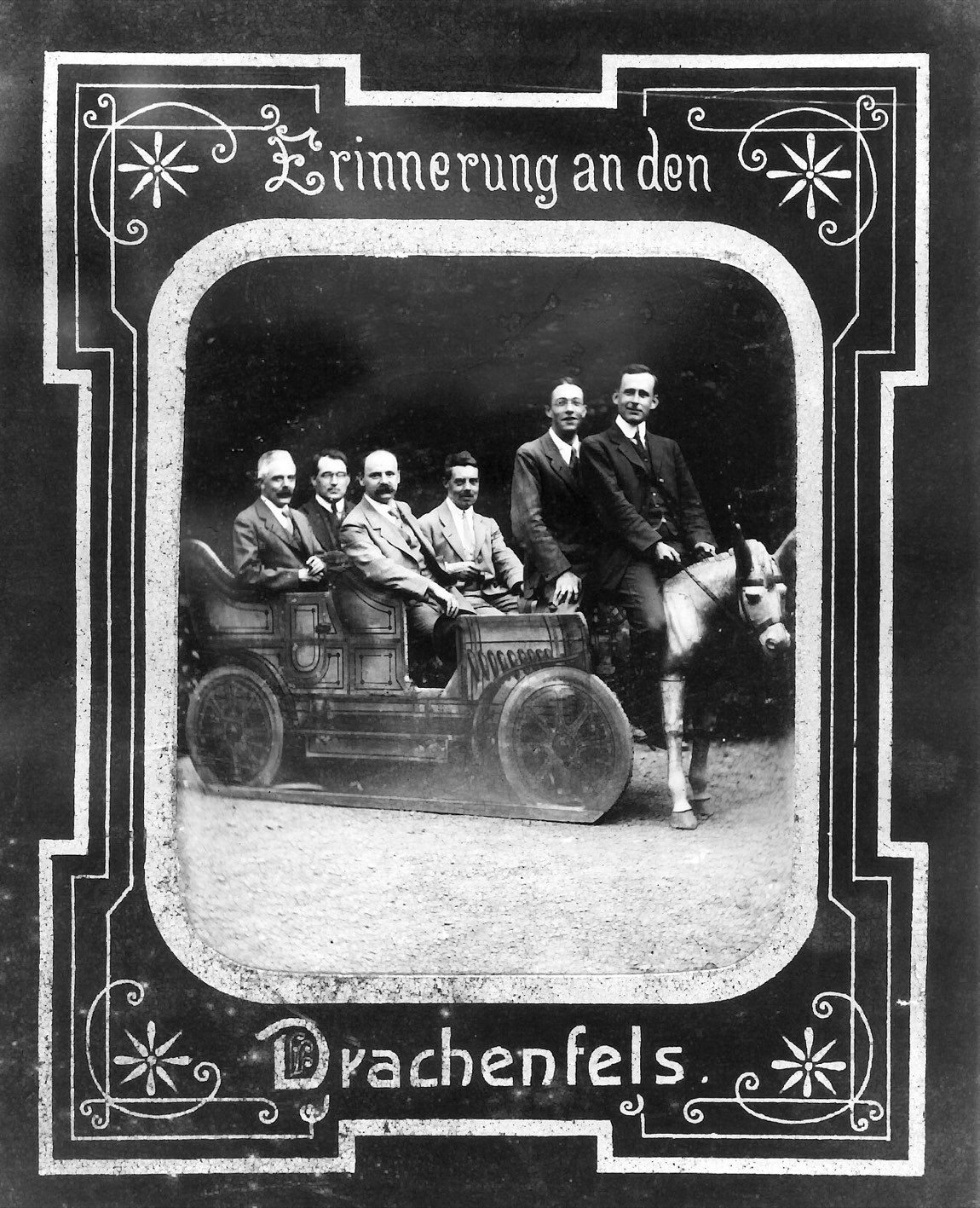
In 1898 Eddington won a scholarship to Owens College, Manchester — now the University of Manchester — where his first year was spent on a general course before he committed fully to physics. Two teachers proved decisive: the physicist Arthur Schuster and the mathematician Horace Lamb. He also lived at Dalton Hall, where the Quaker mathematician J. W. Graham left what the record calls a "lasting influence." Graduating in 1902 with a BSc in physics with First Class Honours, he immediately secured a scholarship to Trinity College, Cambridge. His Cambridge tutor was Robert Alfred Herman. In 1904, still only a second-year student, Eddington became the first ever second-year student to be placed as Senior Wrangler — the top mark in the famously brutal Mathematical Tripos examination. After receiving his MA in 1905 he attempted research on thermionic emission in the Cavendish Laboratory, but the work stalled. A recommendation from his senior colleague E. T. Whittaker redirected him toward the Royal Observatory, Greenwich, where astronomy would consume the rest of his life.
 ⤢
⤢
03 Greenwich, Eros, and a swift rise to prominence
In January 1906, Eddington was nominated chief assistant to the Astronomer Royal at the Royal Observatory, Greenwich, leaving Cambridge the following month. His first major assignment was a detailed analysis of photographic plates recording the parallax of the asteroid 433 Eros — plates that had been accumulating since 1900. To handle the statistical challenge, he devised a method based on the apparent drift of two background stars. The technique was elegant enough to earn him the Smith's Prize in 1907, which in turn brought a fellowship of Trinity College, Cambridge. Advancement came swiftly after that. In December 1912, George Darwin — son of Charles Darwin — died suddenly, and Eddington was promoted to Darwin's chair as Plumian Professor of Astronomy and Experimental Philosophy in early 1913. When Robert Ball, holder of the Lowndean chair, died later that same year, Eddington was named director of the Cambridge Observatory. By May 1914 he was a Fellow of the Royal Society. He was still thirty-one years old.
04 Building the first working model of a star's interior Deeper
Eddington began his theoretical assault on the stellar interior in 1916, starting with Cepheid variable stars. He built on Karl Schwarzschild's earlier work on radiation pressure in Emden polytropic models — mathematical constructions that treat a star as a sphere of gas balanced between gravity and internal thermal pressure. Eddington's key addition was demonstrating that radiation pressure was indispensable; without it, the sphere would collapse. He proceeded knowingly without firm values for opacity or energy generation inside stars, yet argued that the framework was productive enough to justify use despite incomplete foundations. The results allowed calculation of temperature, density, and pressure at every point inside a star. James Jeans contributed the essential insight that stellar matter must be ionized, but that moment of agreement was the extent of their collaboration; the two men became famous for their fierce public debates. Eddington defended his models by pointing to concrete outcomes, above all the mass–luminosity relation he discovered in 1924, which showed that virtually all stars — giants and dwarfs alike — behave as ideal gases. Michelson's 1920 confirmation of Eddington's estimated stellar diameters was pivotal in persuading a skeptical community. The mature theory appeared in 1926 as The Internal Constitution of the Stars, which trained a generation of astrophysicists.
 ⤢
⤢
05 Predicting nuclear fusion before fusion was known Deeper
Around 1920, when the source of stellar energy was, in the article's words, "a complete mystery," Eddington published "The Internal Constitution of the Stars" and correctly speculated that stars are powered by the fusion of hydrogen into helium, releasing energy according to Einstein's equation E = mc². The argument was built from evidence then available: Cepheid variable stars showed no sign of the rotational spin-up that the competing Kelvin–Helmholtz contraction hypothesis demanded. Francis Aston had just measured that a helium atom is about 0.8 percent less massive than the four hydrogen atoms required to assemble it — a deficit that, if released as energy, was enormous. Eddington calculated that if a star contained just 5 percent fusible hydrogen, it would fully account for observed stellar luminosities. He even acknowledged that further elements might be fused, and that stars might be the crucibles forging heavy elements, though insufficient atomic-mass data prevented more. The remarkable thing is that at the time, thermonuclear energy was unknown as a mechanism, and even the fact that stars are largely made of hydrogen had not yet been established. All of Eddington's key speculations were subsequently confirmed.
06 Conscientious objection and the Príncipe expedition
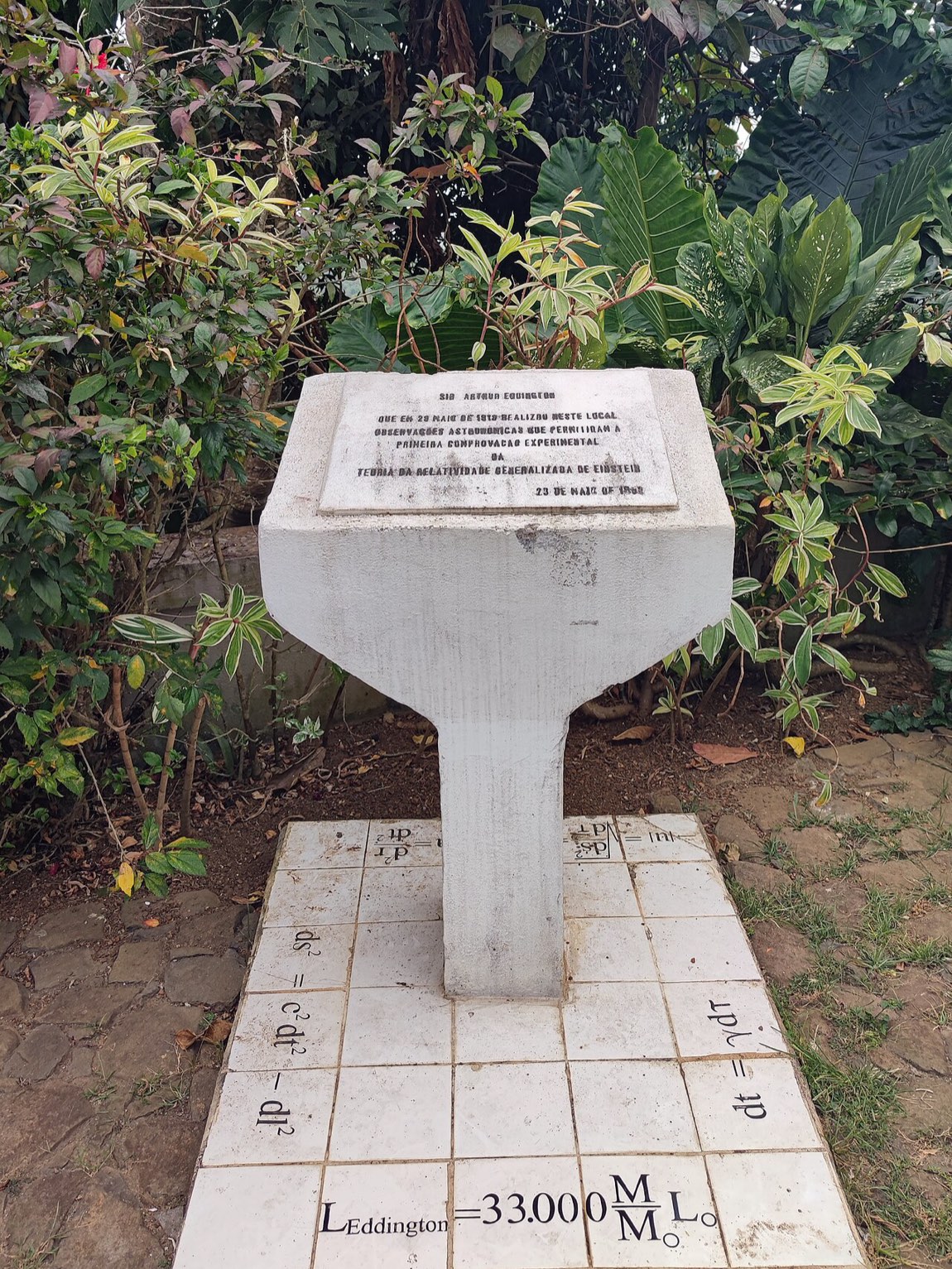
When Britain introduced conscription on 2 March 1916, Eddington intended to apply as a conscientious objector, consistent with his Quaker faith. Cambridge University instead secured him an exemption on the grounds that his scientific work was of national interest. In 1918 the Ministry of National Service appealed against this exemption. At the June 1918 tribunal Eddington stated his personal religious objection to war, but the tribunal did not recognize conscientious objector status. Astronomer Royal Frank Dyson intervened at the July hearing with a written statement stressing Eddington's indispensable role in the planned solar eclipse expedition to the island of Príncipe in May 1919. Eddington had offered to serve in the Friends' Ambulance Unit under the British Red Cross or as a harvest labourer. The tribunal granted a 12-month exemption on condition he continue his astronomy work — specifically preparation for Príncipe. The war ended before the exemption expired. It was thus a combination of Eddington's pacifist principles, Dyson's practical lobbying, and the timing of the armistice that placed him on a volcanic island in the Gulf of Guinea to photograph a solar eclipse that would change physics.
 ⤢
⤢
07 What the 1919 eclipse photographs actually showed
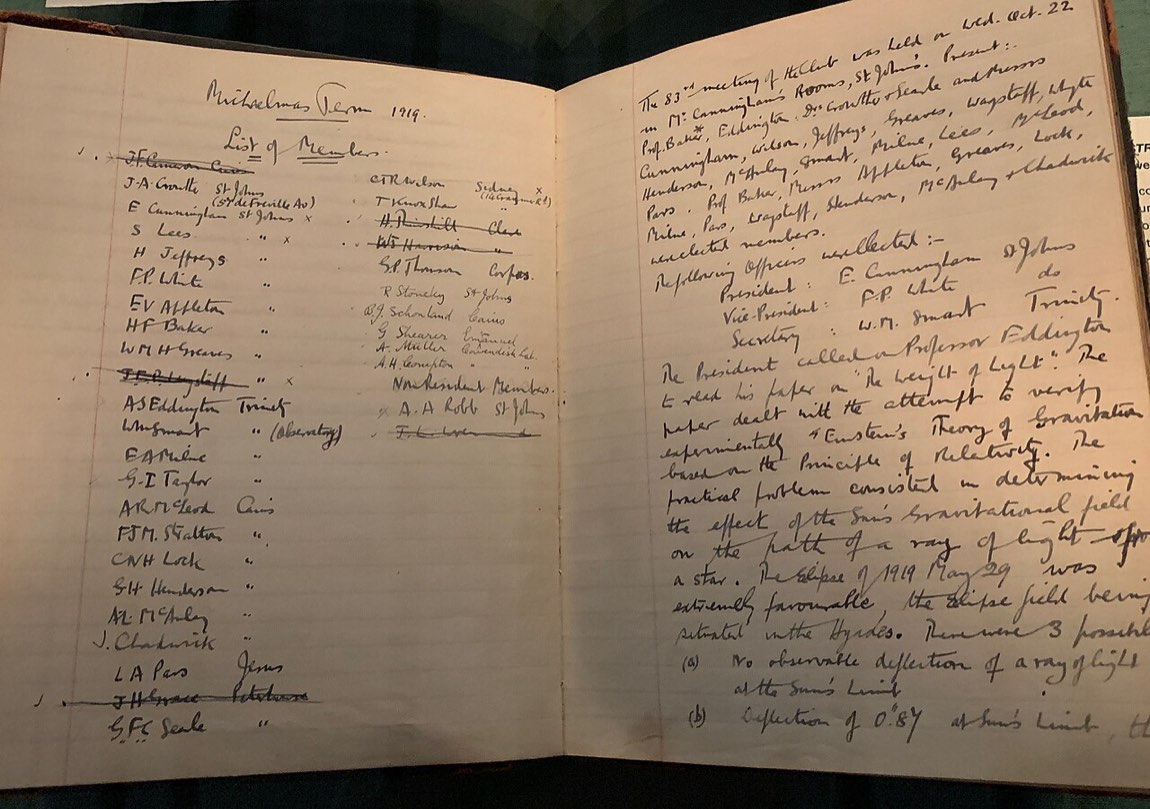
On 29 May 1919 Eddington observed a total solar eclipse from the island of Príncipe, off the west coast of Africa. He photographed stars in the Hyades cluster, including Kappa Tauri in Taurus, whose line of sight from Earth happened to pass near the Sun that time of year. A total eclipse was the only moment such stars could be seen — the Sun's disk normally overwhelms them. General relativity predicted that starlight grazing the Sun would be deflected by the Sun's gravitational field; Eddington had already established that a Newtonian interpretation of light-bending would predict only half the relativistic deflection. His published results appeared to confirm Einstein's prediction. A simultaneous expedition to Sobral, Brazil, produced data initially seeming closer to the Newtonian value, but those results were set aside because of a confirmed defect in the telescopes used — a conclusion accepted by astronomers at the time. Subsequent criticism held that Eddington's plates were of poor quality, but a 1979 re-analysis using modern measuring equipment and software validated his results and conclusions. The quality was indeed lower than later eclipse observations would achieve, yet it was sufficient to persuade the scientific community of the day.
08 The Chandrasekhar dispute and its long shadow Deeper
In the late 1920s and 1930s, Eddington extended his stellar models using advances in quantum physics, including degeneracy physics applied to dwarf stars. This work brought him into conflict with Subrahmanyan Chandrasekhar, then a student at Cambridge. Chandrasekhar's mathematical analysis of degenerate stellar matter presaged the concept of black holes. Eddington refused to accept that the derivation had physical consequences, apparently finding the implied singularities too non-physical to credit — a position the article says was partly rooted in suspicion that pure mathematical reasoning from relativity was insufficient to resolve the real paradoxes of degenerate stars, but that he also "raised irrelevant objections," in the words of physicist Thanu Padmanabhan. Chandrasekhar's own account portrays Eddington as cruel and dogmatic. Yet the article records that it was Eddington and Edward Arthur Milne who sponsored Chandrasekhar's fellowship of the Royal Society, giving him a seat at Cambridge's highest table and a comfortable research endowment. The episode illustrates one of the stranger tensions in twentieth-century science: the man who most powerfully built stellar physics also blocked, for years, its most consequential extension.
 ⤢
⤢
09 Fundamental theory and a famous arithmetic blunder Deeper
From the 1920s until his death, Eddington devoted increasing energy to what he called "fundamental theory" — an attempted unification of quantum mechanics, relativity, cosmology, and gravitation. His method involved combining fundamental constants to produce dimensionless numbers, many of which clustered near 1040, its square, or its square root. He was convinced the proton mass and electron charge were a "natural and complete specification for constructing a Universe." Paul Dirac pursued related ideas, now called the Dirac large numbers hypothesis. Eddington's credibility suffered badly, however, over his treatment of the fine-structure constant. When measurements put it near 1/136, he argued it must be exactly 1/136 for epistemological reasons. When improved measurements pointed clearly to 1/137, he shifted the argument to claim it must be exactly 1/137 — the number that bears his name. Critics of the day began calling him "Arthur Adding-one." As of 2022, the CODATA value stands at 1/137.035999177(21), confirming neither exact figure. He also predicted the number of hydrogen atoms in the observable universe as 136 × 2²⁵⁶, approximately 1.57 × 10⁷⁹. His book Fundamental Theory was published posthumously in 1948, left incomplete at his death.
10 Eddington as Britain's voice for Einstein
World War I had severed scientific communication across Europe, and German physics was poorly understood in Britain. During the war, Eddington served as secretary of the Royal Astronomical Society and was thus the first British scientist to receive a sequence of letters and papers from Willem de Sitter explaining Einstein's general relativity. He was among the very few English astronomers with the mathematical preparation to follow the theory, and his Quaker internationalism made him willing to champion work by a German physicist at a moment of intense national hostility. He swiftly became general relativity's chief British advocate. His 1923 collection The Mathematical Theory of Relativity drew from his public lectures; Einstein himself called it "the finest presentation of the subject in any language." A famous exchange at the Royal Society meeting of 6 November 1919 captures his standing: physicist Ludwik Silberstein told Eddington that only three people truly understood relativity. When Eddington stayed silent, Silberstein pressed him not to be shy. Eddington replied: "Oh, no! I was wondering who the third one might be!"
11 Philosophy: mind-stuff, free will, and two tables
Eddington's philosophical writing attracted a wide public readership between the wars. In The Nature of the Physical World he argued that "the stuff of the world is mind-stuff," a phrase that provoked both admiration and irritation. He reasoned that because relativity and quantum physics had discarded mechanical theories of matter, a strictly materialist metaphysics was obsolete; and since materialism and idealism were taken as exhaustive alternatives, idealism followed. He also argued that whatever we observe must ultimately arrive as content of consciousness, so no observation could confirm that an objective world possesses material properties independently. He was careful, however — as Charles De Koninck noted — to insist on an objective reality existing apart from mind; the moon has mass when no one measures it, is 240,000 miles from Earth when no one surveys it, and would eclipse the sun in 1999 even if humanity had destroyed itself. Separately, his celebrated image of "two tables" — the familiar solid surface versus the physicist's table of darting charged particles in near-empty space — became one of the most widely quoted illustrations of the gap between everyday experience and scientific description. Against Einstein's determinism, Eddington championed indeterminism, arguing that quantum uncertainty reflects something genuinely undetermined in nature, not merely a limit of human knowledge.
12 Honours, namesakes, and a cycling metric
Eddington accumulated honours steadily across his career: the Smith's Prize in 1907, the Bruce Medal, Henry Draper Medal, and Gold Medal of the Royal Astronomical Society all in 1924, the Royal Medal in 1928, a knighthood in 1930, and the Order of Merit in 1938. He served as president of the Royal Astronomical Society from 1921 to 1923 and of the International Astronomical Union. A lunar crater, the asteroid 2761 Eddington, and the Royal Astronomical Society's Eddington Medal all carry his name. The new Cambridge suburb of Eddington, opened in 2017, honours him in his adopted city. Less formally, he is credited with inventing a cycling performance metric: the maximum number E such that a rider has cycled at least E miles on at least E days. Eddington's own lifetime cycling E-number was 84 — meaning he had ridden at least 84 miles in a day on at least 84 separate occasions. The metric is deliberately hard to improve at high values, since each incremental step demands not just a few new long rides but specifically long-enough ones to count. Eddington died of cancer in Cambridge on 22 November 1944. He was unmarried; his remains were buried with his mother's in the Ascension Parish Burial Ground, Cambridge.