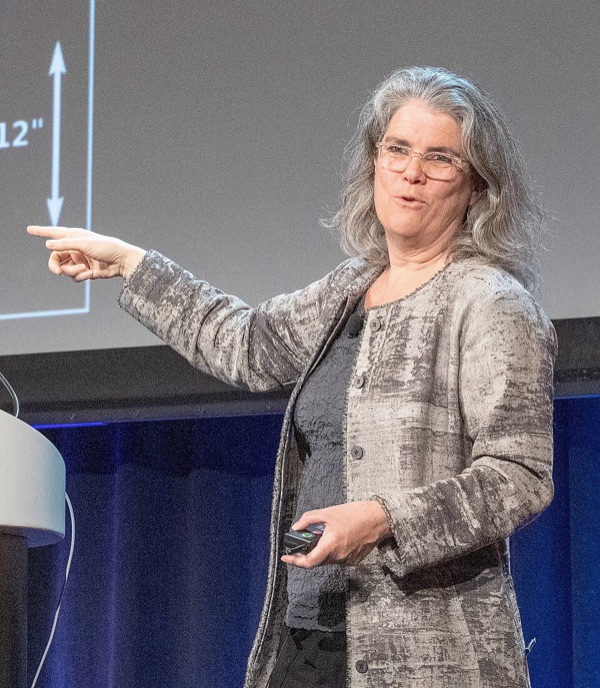
 BorderlineRebel · CC BY-SA 4.0
Astrophysics · 1965-
Andrea Ghez
Tracking stars around the Milky Way's black hole
The story
Ghez's UCLA group spent decades sharpening infrared imaging — pioneering adaptive-optics techniques — to track single stars whipping around the galactic center. The orbits her team measured proved a four-million-solar-mass object hides there: a supermassive black hole, weighed star by star.
Why it matters
She shared the 2020 Nobel Prize in Physics — the fourth woman ever — for the most direct evidence yet that supermassive black holes are real, anchoring this site's Sagittarius A* pages.
The deep dive
Researched for the Atlas from Wikipedia — Andrea M. Ghez (7,873 characters read) · updated Sep 20, 2026
01 From Moon landings to black holes
Andrea Mia Ghez was born on June 16, 1965, in New York City, to a family that crossed several continents and cultures. Her father, Gilbert Ghez, was of Jewish heritage, born in Rome to a family originally from Tunisia and Frankfurt, Germany. Her mother came from an Irish Catholic family in North Attleborough, Massachusetts. The household moved to Chicago in 1969 when Gilbert completed his PhD at Columbia University and joined the University of Chicago faculty. That connection gave young Andrea access to the university's Laboratory School — an intellectually charged environment that shaped her early years. What ignited her ambition, however, was watching the Apollo program Moon landings. She decided she wanted to be the first female astronaut. Her mother responded by buying her a telescope, a gift whose symbolic weight is hard to overstate. A high school chemistry teacher later became her most influential female role model, nudging her from broad scientific curiosity toward the rigorous habits of mind that serious research demands.
02 The education that built the scientist
Ghez began college as a mathematics major before pivoting to physics — a shift that pointed her toward the quantitative but observationally grounded career ahead. She earned a Bachelor of Science in physics from the Massachusetts Institute of Technology in 1987, during which time she was a member of the fraternity of St. Anthony Hall, an unusual social affiliation that reflects the eclectic world she moved through. Her doctoral work took her to the California Institute of Technology, where she worked under the direction of Gerry Neugebauer — himself a pioneering infrared astronomer — and received her PhD in 1992. The Caltech environment was steeped in infrared astronomy, and that technical tradition followed Ghez throughout her career. The choice to study at institutions with strong observational programs rather than purely theoretical ones meant she arrived at UCLA already fluent in the instrumental language she would need to look through dust and into the heart of the galaxy.
03 Why infrared light was the key
The center of the Milky Way is hidden behind enormous clouds of interstellar dust that completely block ordinary visible light — the kind human eyes detect and conventional photographs record. Ghez's crucial methodological insight was to image the Galactic Center at infrared wavelengths, which pass through that dust far more freely. Using the W. M. Keck Telescope, whose primary mirror spans 10 meters across — roughly the length of a school bus — she and her colleagues achieved imaging sharp enough to track individual stars near the center. Even the Keck's immense aperture would have been blurred by Earth's turbulent atmosphere had it not been for adaptive optics, a technology that measures atmospheric distortion in real time and corrects for it by flexing a deformable mirror hundreds of times per second. Together, infrared sensitivity and adaptive optics gave Ghez the equivalent of a new pair of eyes — ones that could see where no optical telescope had ever looked clearly before.
04 Tracking stars to weigh a black hole Deeper
Beginning in 1995, Ghez and her team at UCLA began systematically recording the positions of stars packed into the tiny region surrounding Sagittarius A*, the compact radio source at the Milky Way's center. Over years of observations, those positions traced curved paths — orbits governed by the gravity of whatever mass lay at the center. One star, designated S2, completed a full elliptical orbit across the span of the observational campaign. A second star, S0-102, was identified by her team in October 2012. Applying Kepler's third law — which links an orbit's size and period directly to the central mass — Ghez's team calculated that Sagittarius A* contains 4.1 ± 0.6 million solar masses packed into a region far too small to be any ordinary cluster of objects. Because the Galactic Center is one hundred times closer than M31, home of the next nearest supermassive black hole, Sgr A* became one of the best-demonstrated cases for a supermassive black hole anywhere in the universe. The article notes that several more decades of observation will be needed to fully document some of the longer-period stellar orbits.
05 A working relationship and a rivalry Deeper
Ghez did not work in isolation. Her Nobel Prize was shared with Reinhard Genzel, a German astrophysicist whose group at the Max Planck Institute conducted the first major study of galactic center kinematics — the baseline against which later work was measured. The article explicitly notes that the high resolution of the Keck telescopes gave Ghez's program a significant improvement over Genzel's earlier results, which frames their relationship as simultaneously collaborative — both chasing the same physical truth — and competitive, each group pushing spatial resolution and orbital completeness further than the other. The Nobel committee ultimately recognized both efforts as jointly responsible for the discovery. Ghez and Genzel shared one half of the 2020 prize equally; the other half went to Roger Penrose for separate theoretical work on black holes. That three-way division reflects how the Nobel committee saw the discovery: empirical confirmation of a supermassive black hole at the galactic center was the work of two rival observational teams who needed each other's existence to keep the science honest.
06 Being the fourth woman to win physics Nobel
When Ghez received the Nobel Prize in Physics in 2020, she became only the fourth woman to do so since the prize was established. The three who preceded her were Marie Curie in 1903, Maria Goeppert Mayer in 1963, and Donna Strickland in 2018 — a list whose gaps speak for themselves. The sixty-year interval between Curie and Goeppert Mayer, and the fifty-five years between Goeppert Mayer and Strickland, underscore how rare this recognition has been for women in physics regardless of the quality of their work. Ghez had already accumulated a formidable record of earlier honors: the Annie J. Cannon Award in Astronomy in 1994, a Packard Fellowship in 1996, the Newton Lacy Pierce Prize in 1998, a MacArthur Fellowship in 2008, and the Crafoord Prize in Astronomy in 2012, among others. The Nobel capped a career in which institutional recognition had come steadily but which the prize elevated to a different cultural register entirely.
07 A star that should not exist Deeper
One of the more unsettling scientific puzzles that emerged from Ghez's observations involved the nature of the stars orbiting Sgr A* so closely. In a 2003 paper, her team reported the first measurement of spectral lines — the chemical fingerprints embedded in starlight — from a short-period star bound to the galaxy's central black hole. The paper's subtitle called it "A Paradox of Youth." The paradox is real: the intense tidal forces near a supermassive black hole should shred the gas clouds from which new stars form, making star formation in that region essentially impossible. Yet young stars are clearly present there. How they formed, or whether they migrated inward from safer distances, remained an open question the article does not resolve. This kind of productive puzzle — a measurement that answers one question while opening several more — is characteristic of what high-resolution galactic center astronomy has generated, and it illustrates why the region continues to attract intense observational effort.
08 Tests of general relativity at the galactic center Deeper
Albert Einstein's general theory of relativity makes precise predictions about how gravity behaves in extremely strong gravitational fields, predictions that differ measurably from those of Newtonian gravity. The densely packed orbits of stars around Sagittarius A* offer an extraordinary natural laboratory for testing those predictions. The article notes explicitly that the measurements Ghez's team has accumulated may provide a test of general relativity — carefully worded language that reflects where the science stood at the time of writing. The 2008 paper by Ghez and colleagues, titled "Measuring Distance and Properties of the Milky Way's Central Supermassive Black Hole with Stellar Orbits," is listed among her selected publications and represents a significant step in that program: using stellar orbits not just to confirm the black hole's existence but to measure its properties with enough precision that deviations from relativistic predictions could in principle be detected. The orbits of short-period stars like S2 are close enough to the black hole that relativistic effects — precession of the orbital ellipse, gravitational redshift of the star's light — become detectable with sufficiently precise instruments.
09 Early career work on young binary stars Deeper
Before Ghez became synonymous with the galactic center, her early research addressed a different question: how often do young stars form as pairs or multiples rather than as singles. Her 1993 paper with Neugebauer and Matthews — one of her first major publications — surveyed T Tauri stars in the Taurus-Auriga and Ophiuchus-Scorpius star-forming regions at 2.2 microns, a near-infrared wavelength, to measure the multiplicity of these young pre-main-sequence objects. Follow-on work published in 1997 used high spatial resolution imaging to study the relationship between close companions and the circumstellar disks from which planets eventually form. This body of work established Ghez as a practitioner of high-resolution infrared imaging and gave her the technical fluency that she would later apply, at vastly larger scales, to the stars orbiting a four-million-solar-mass black hole. The thread connecting young binary stars and galactic center dynamics is the same instrument and technique: pushing spatial resolution to its physical limits.
10 Communicating science beyond the campus
Ghez has invested considerable effort in taking her science to audiences outside research institutions. She has appeared in television documentaries on the BBC, Discovery Channel, and History Channel, and in 2006 featured in an episode of the PBS series Nova. In 2009 she delivered a TED talk titled "The Hunt For a Supermassive Black Hole," a format designed to reach the broadest possible curious public. She co-authored a children's book, You Can Be a Woman Astronomer, with Judith Love Cohen, published in 2006 — a direct echo of the encouragement her own mother provided when she was a child dreaming about astronauts. She gave the 53rd George Gamow Memorial Lectures, titled "From the Possibility to the Certainty of a Supermassive Black Hole," a title that itself traces the arc of her career's central argument. The My Hero Project identified her as a Science Hero. In lectures to students, the article notes, she has emphasized the importance of critical thinking — the same habit she credits as central to her own scientific practice.
11 Institutional recognition across two decades
The pace and breadth of honors Ghez received across her career map a steady climb through astronomy's recognition structures. Early career prizes — the Annie J. Cannon Award in 1994, the Packard Fellowship in 1996, the Sloan Research Fellowship, and the Newton Lacy Pierce Prize in 1998 — marked her as an exceptional emerging scientist. The Maria Goeppert-Mayer Award from the American Physical Society followed in 1999. Election to the National Academy of Sciences came in 2004, and a MacArthur Fellowship — the so-called genius grant — in 2008. The Crafoord Prize in Astronomy, awarded by the Royal Swedish Academy of Sciences in 2012, is one of the most prestigious prizes in sciences not covered by the Nobel at the time of award; that she then received the Nobel eight years later is unusual and speaks to the sustained accumulation of evidence her team produced. She was elected a Fellow of the American Physical Society in 2019 and a Legacy Fellow of the American Astronomical Society in 2020, the same year as the Nobel Prize.
12 Her position and research group at UCLA
Ghez holds a named professorship at the University of California, Los Angeles: the Lauren B. Leichtman and Arthur E. Levine Chair in Astrophysics, within the Department of Physics and Astronomy. Named chairs typically represent the highest tier of faculty appointment at a research university and come with discretionary research funds. The Keck Observatory, which provides the 10-meter telescope she depends on for galactic center observations, is operated as a partnership and sits atop Mauna Kea in Hawaii. Her research group has published work spanning stellar multiplicity, disk evolution, stellar dynamics at the galactic center, and tests of fundamental physics — a range that reflects how a single instrument capability, high-resolution infrared imaging, can be brought to bear on many different astrophysical problems. The article also notes that she is an active swimmer in the UCLA Masters Swim Club, a reminder that the person conducting this decades-long observational campaign inhabits an ordinary life alongside the extraordinary science.