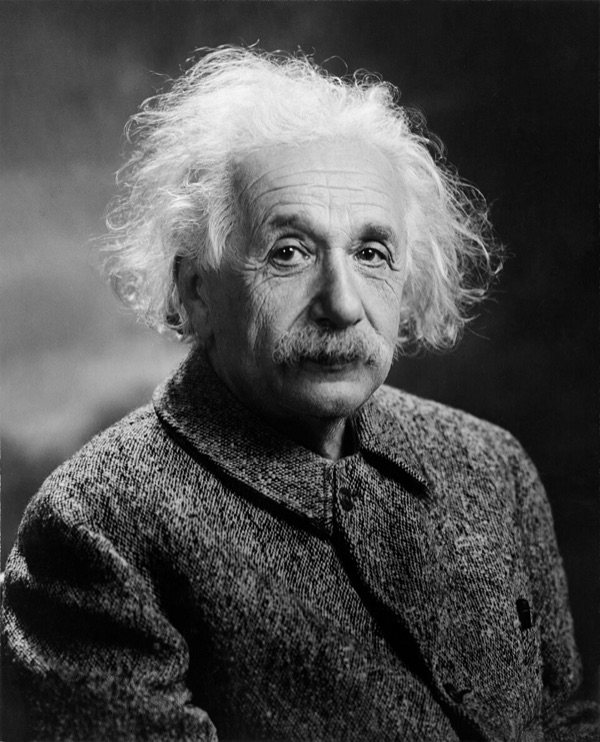
 Oren Jack Turner · Public domain
Physics · 1879–1955
Albert Einstein
Relativity, the modern theory of space, time and gravity
The story
In 1905 Einstein rewrote motion, light and energy (E=mc²); in 1915 he rewrote gravity itself: mass curves space-time. He predicted light-bending (confirmed 1919, making him world-famous), gravitational waves (confirmed 2015) — and doubted black holes, which his own equations demanded.
Why it matters
Every GPS fix, every black-hole image, every cosmological model runs on his mathematics. Relativity remains unbeaten by a century of increasingly brutal tests.
The deep dive
Researched for the Atlas from Wikipedia — Albert Einstein (58,000 characters read) · updated Sep 20, 2026
01 A compass and a hidden order
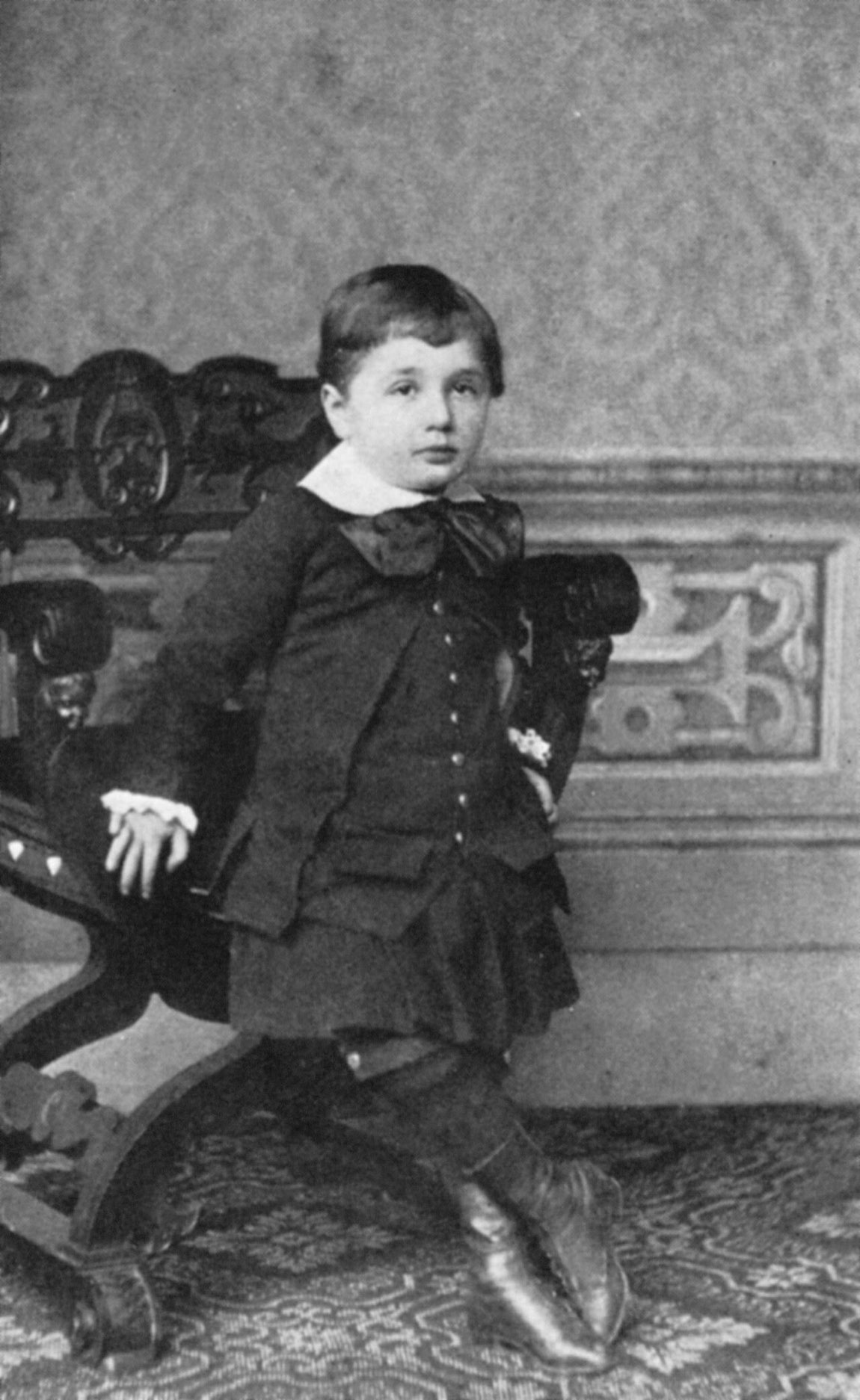
When Einstein was five years old and sick in bed, his father brought him a magnetic compass. The needle's stubborn pointing, trembling invisibly in response to something unseen, seized the boy with a feeling he later described as the conviction that "something deeply hidden had to be behind things." That single childhood object planted the seed of a lifelong obsession with electromagnetism. Within a few years he was teaching himself algebra, calculus, and Euclidean geometry at age twelve, and before his thirteenth birthday he had worked out an original proof of the Pythagorean theorem entirely on his own. His tutor, Max Talmud, recalled that after giving the twelve-year-old a geometry textbook, the boy had worked through the whole volume so quickly that Talmud could no longer follow his progress. By fourteen, Einstein later recorded, he had "mastered integral and differential calculus." By age twelve he was already confident that nature could be understood as a "mathematical structure" — a belief that would govern every major theory he ever built.
02 The fractious student who fled Munich
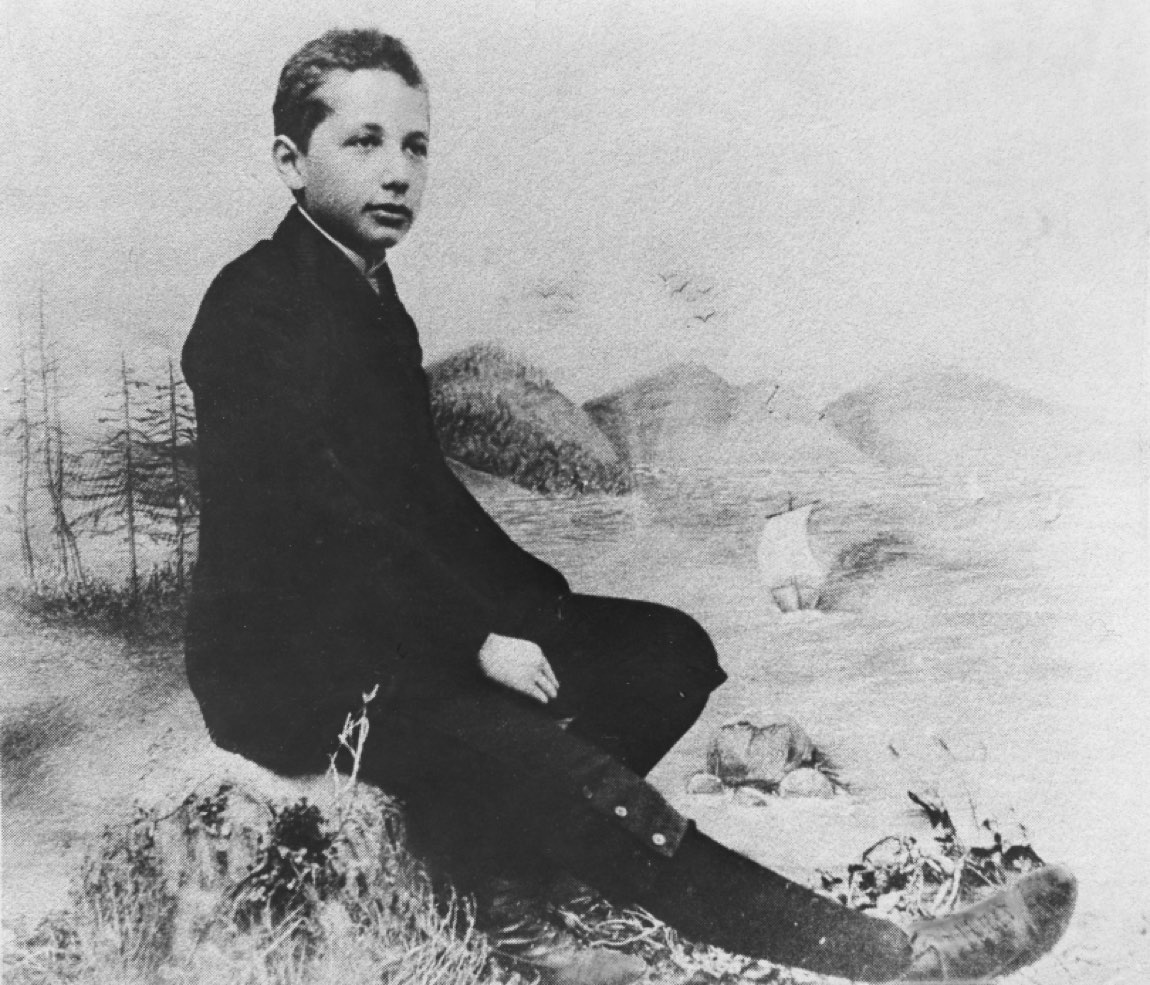
Einstein's path through formal schooling was anything but smooth. He chafed badly at the Luitpold Gymnasium's policy of strict rote learning, which he later argued was actively harmful to creativity. When his father's electrical equipment company failed to win the Munich contract to install electric lighting — the family firm lacked the capital to upgrade from direct current to the more efficient alternating current — the Einsteins relocated to Italy, first to Milan and then to Pavia. The fifteen-year-old Albert stayed behind to finish school but soon engineered his own exit, obtaining a doctor's letter that persuaded the school to release him. He joined his family in Pavia at the end of December 1894. During his Italian interlude he wrote a teenage essay titled "On the Investigation of the State of the Ether in a Magnetic Field" — an early sign that the questions driving the future theory of special relativity were already forming in his mind. The following year, at sixteen, he sat the entrance examination for the federal polytechnic school in Zurich, passed physics and mathematics with distinction, but failed the general part of the test — and had to spend an extra year at a cantonal school in Aarau, Switzerland, before gaining admission.
03 Mileva Marić and the contested miracle year Deeper
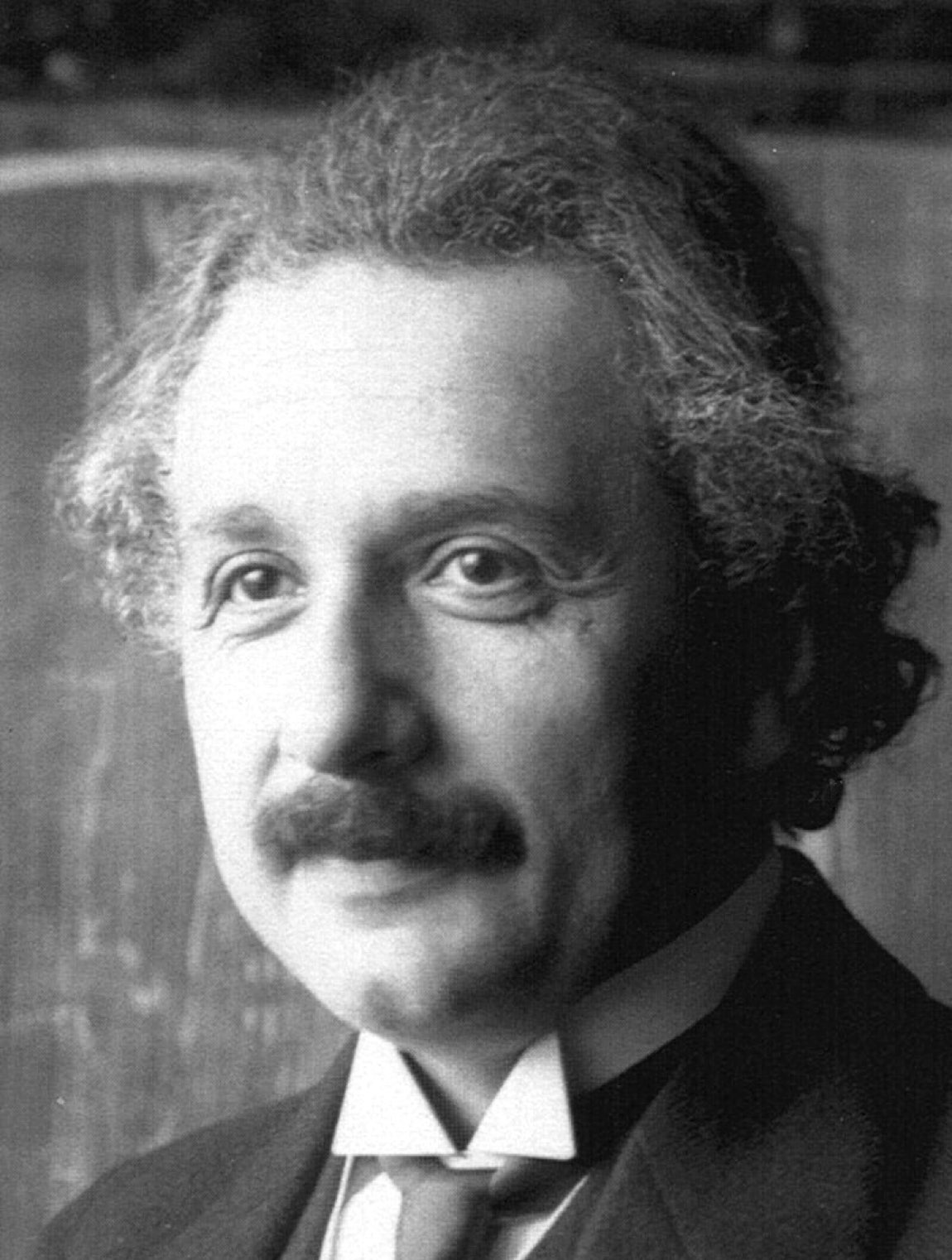
Among the handful of students who enrolled alongside Einstein in the mathematics and physics teaching diploma program at the federal polytechnic school in 1896 was Mileva Marić, a twenty-year-old Serbian woman and the only female in the group following the same course. Over the next several years the two spent long hours discussing topics in physics that the school's lectures did not cover, and Einstein confessed in letters that exploring science with her by his side was far more enjoyable than reading a textbook alone. The pair became lovers and eventually married in January 1903. Historians of physics remain genuinely divided on how much Marić contributed to the insights behind Einstein's four landmark 1905 papers. There is at least some evidence that her scientific ideas influenced him, but other scholars argue her impact on his thought was not of great significance. The question has never been definitively settled. The divorce settlement struck in February 1919 contained a telling clause: Einstein promised to hand over any future Nobel Prize money to Marić — and he won the prize just two years later, in 1922 for the 1921 award, making good on that promise.
 ⤢
⤢
04 The Olympia Academy and patent-office physics
After graduating in 1900, Einstein spent nearly two years failing to find a teaching post at any Swiss school. It was only through the intervention of Marcel Grossmann's father that he secured a job as an assistant examiner — level III — at the Swiss Patent Office in Bern, a position that became permanent in 1903. Patent applications landing on his desk included a gravel sorter and an electric typewriter. Far from deadening his intellect, the job may have sharpened it: his revolutionary ideas about space, time, and light grew from thought experiments about signal transmission and the synchronization of clocks — exactly the kind of practical problems he evaluated daily. In parallel, he and two friends, Conrad Habicht and Maurice Solovine, formed the Olympia Academy, a small reading group that met regularly to discuss science and philosophy. The name was a wry joke at its own modest status. The thinkers they worked through — Henri Poincaré, Ernst Mach, and David Hume — significantly shaped Einstein's subsequent ideas. Marić occasionally joined the sessions, though she limited herself to careful listening.
05 Four papers in one miracle year
In 1905, a year sometimes called his annus mirabilis, Einstein published four papers in the journal Annalen der Physik that collectively redirected the course of physics. The first explained the photoelectric effect by treating light as discrete particles — the work for which he eventually received the Nobel Prize. The second showed that Brownian motion, the jittery movement of tiny particles suspended in a liquid, offered firm statistical evidence that molecules actually exist. The third introduced special relativity, reconciling Maxwell's equations of electromagnetism with Newtonian mechanics by revising the laws of mechanics themselves, and arguing that the concept of a luminiferous aether was superfluous. The fourth derived E = mc², demonstrating that mass and energy are equivalent. All four appeared while he was still a patent-office examiner. That same year he also submitted his 24-page doctoral dissertation, "A New Determination of Molecular Dimensions," to the University of Zurich, though his PhD was not formally awarded until 15 January 1906. The comparison made at the time was to Isaac Newton's miracle year of 1666, when Newton experienced his greatest scientific epiphanies.
06 From special to general relativity, step by step Deeper
The leap from special to general relativity took Einstein a full decade of struggle. In 1907 he formulated the equivalence principle — the insight that an observer in a freely falling box cannot detect the gravitational field around them — which he recognized as a crucial milestone. By 1911 he had produced a first calculation of the gravitational deflection of light passing close to the Sun. In 1912 he returned to ETH Zurich, where his friend Marcel Grossmann, whose mathematical knowledge exceeded his own, helped him deploy the Riemann curvature tensor of a non-Euclidean four-dimensional spacetime as the tool for modeling gravitation. By the fall of 1915 the reimagining of gravity in terms of Riemannian geometry was complete. Einstein applied the finished theory not only to the Sun's role as a gravitational lens but also to the precession of the perihelion of Mercury — the slow drift of the point in Mercury's orbit where it comes closest to the Sun — which Newtonian mechanics had never fully accounted for. The definitive observational test came on 29 May 1919, when a total solar eclipse allowed Sir Arthur Eddington to measure the bending of starlight around the Sun. His results were consistent with Einstein's calculations. On 7 November 1919 The Times of London ran the banner headline: "Revolution in Science — New Theory of the Universe — Newtonian Ideas Overthrown."
 ⤢
⤢
07 The 1916 cosmological paper and the laser's seed Deeper
General relativity quickly branched into new territory. The paper Einstein published in 1916, the year after completing the theory, laid out its implications for the structure and evolution of the universe as a whole, introduced the cosmological constant, and is regarded as the founding document of modern theoretical cosmology. Then in 1917 he published another paper that introduced two concepts destined to outlive their author in unexpected ways: spontaneous emission and stimulated emission. Stimulated emission — the process by which an incoming photon triggers an atom to release an identical photon — is the core physical mechanism behind the laser and the maser. Einstein did not build a laser, but every laser built since then operates on the principle he described in that paper. The 1917 work also contained material that later proved valuable to the development of quantum electrodynamics and quantum optics. In this sense, a single paper from Einstein's Berlin years seeded both the cosmological worldview that underpins modern astronomy and the photon-amplification technology found today in everything from supermarket scanners to gravitational-wave detectors.
08 Bose, photons, and a reluctant quantum pioneer Deeper
Einstein's relationship with quantum theory was complicated. He was in one sense its co-founder: his 1905 paper on the photoelectric effect treated light as composed of discrete particles — what we now call photons — and it was this work, not relativity, that the Nobel committee specifically cited when awarding him the 1921 prize. The Nobel citation itself displayed a degree of caution, declining to endorse Einstein's notion of the particulate nature of light outright; that idea only won over the entire scientific community when the Indian physicist Satyendra Nath Bose derived the Planck spectrum in 1924. Working from Bose's letter, Einstein extended the statistical framework Bose had applied to photons to material particles, laying the groundwork for what is now called Bose–Einstein statistics. Yet Einstein spent much of the second half of his career fighting what quantum mechanics had become, objecting to its introduction of fundamental randomness into science with the famous declaration that "God does not play dice." He also attempted to construct a unified field theory that would fold electromagnetism into his geometric account of gravitation, and he failed on both fronts, growing increasingly isolated from the mainstream physics community as a result.
09 Fame, eclipse, and celebrity in a new era
Eddington's eclipse observations of 1919 transformed Einstein almost overnight into what contemporaries described as "perhaps the world's first celebrity scientist" — a genius who had overturned a paradigm basic to physics since the seventeenth century. He arrived in New York City on 2 April 1921, welcomed by Mayor John Francis Hylan, and spent three weeks giving lectures at Columbia University and Princeton, visiting the White House with members of the National Academy of Sciences, and returning to Europe via London as the guest of Viscount Haldane. The following year he spent six months touring Asia, lecturing in Japan, Singapore, and Sri Lanka. After his first public lecture in Tokyo, thousands thronged the streets hoping to glimpse him, and he met Emperor Yoshihito at the Imperial Palace. In December 1930 he began another extended US visit, drawn by a two-month fellowship at Caltech. He attended a Hanukkah celebration at Madison Square Garden alongside a crowd of 15,000 people, was given the keys to New York City by Mayor Jimmy Walker, and accompanied Charlie Chaplin to the Hollywood premiere of City Lights. Chaplin's now-famous remark captured the paradox of Einstein's celebrity: "They cheer me because they understand me, and they cheer you because no one understands you."
 ⤢
⤢
10 Exile, the Nazi threat, and the atomic letter
In February 1933, while visiting the United States for his third two-month fellowship at Caltech, Einstein learned that Adolf Hitler had become Germany's chancellor. He immediately knew he could not return. On 28 March 1933, landing in Antwerp, Belgium, he walked into the German consulate and surrendered his passport, formally renouncing his German citizenship. The Nazi government eventually revoked it on 24 March 1934, sold his sailboat, and converted his cottage into a Hitler Youth camp. Nazi propaganda minister Joseph Goebbels proclaimed "Jewish intellectualism is dead" during the book burnings that included Einstein's works; one German magazine listed him as an enemy of the regime with the phrase "not yet hanged" and placed a $5,000 bounty on his head. In July 1939, a few months before war broke out in Europe, Leó Szilárd and Eugene Wigner visited Einstein to explain the possibility of atomic bombs — something Einstein, a pacifist, said he had never considered. He co-signed a letter with Szilárd to President Franklin D. Roosevelt alerting him to German nuclear weapons research and recommending that the United States begin its own program, work later carried out as the Manhattan Project. In 1954, a year before his death, Einstein told his friend Linus Pauling: "I made one great mistake in my life — when I signed the letter to President Roosevelt recommending that atom bombs be made."
11 Princeton, civil rights, and final years
Einstein took up a resident scholarship at the Institute for Advanced Study in Princeton, New Jersey on 7 October 1933, four days after delivering a speech on academic freedom to a packed Royal Albert Hall in London. He was one of the four scholars first selected for the new Institute, alongside John von Neumann, Kurt Gödel, and Hermann Weyl. He and Gödel developed a close friendship, taking long walks together to discuss their work. Einstein became an American citizen in 1940 and lived in Princeton at his home from 1935 until his death; that house was later designated a National Historic Landmark in 1976. He joined the NAACP, corresponded with W. E. B. Du Bois, and called racism America's "worst disease." In 1946 he visited Lincoln University in Pennsylvania — the first American university to grant degrees to African Americans — where he received an honorary degree and gave a speech about racism. When soprano Marian Anderson came to Princeton for a concert in 1937 and was refused a room at the Nassau Inn, Einstein invited her to stay at his home on Main Street; she returned to stay with him each time she visited Princeton. He died in Princeton Hospital on 18 April 1955 at the age of 76, of a ruptured abdominal aortic aneurysm, having refused surgery the previous day.
12 Legacy in names, numbers, and open questions
Einstein published more than 300 scientific papers and 150 non-scientific ones over his lifetime. Universities and archives announced the release of more than 30,000 unique documents from his papers on 5 December 2014. The reach of his ideas into modern science is hard to overstate: the cosmological constant he introduced in 1916 is today invoked to describe dark energy; stimulated emission underpins every laser ever built; Bose–Einstein statistics govern the behavior of superfluids and Bose–Einstein condensates; and the gravitational lensing he predicted is now a standard tool of observational astronomy. The chemical element einsteinium, atomic number 99, is named after him. In 1999 Time magazine named him Person of the Century. His 1917 paper on radiation anticipated quantum electrodynamics and quantum optics. His FBI dossier, opened in 1932, eventually ran to 1,427 pages. His brain was removed without family permission during the autopsy performed by pathologist Thomas Stoltz Harvey, who preserved it in the hope that future neuroscience would explain what made him so intellectually extraordinary — a question that remains, appropriately, unanswered.