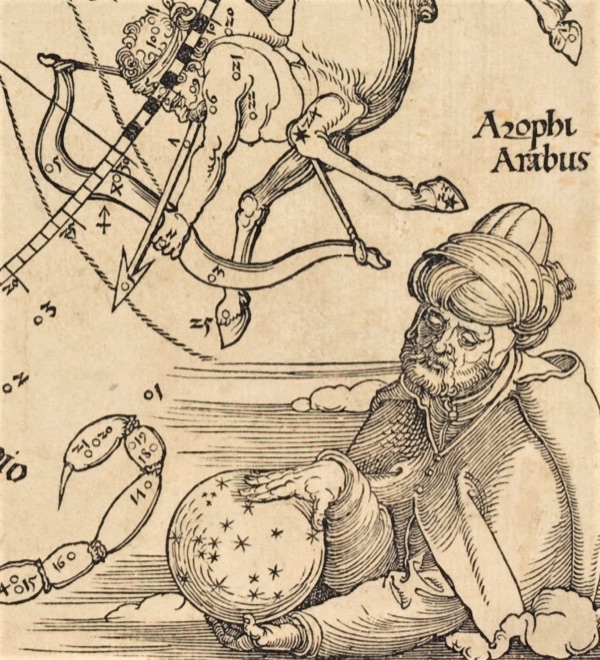
 Albrecht Dürer · CC BY-SA 4.0
Astronomy · 903-986
Abd al-Rahman al-Sufi
The Book of Fixed Stars, and the first recorded galaxy
The story
Working in Persia, al-Sufi merged Greek astronomy with Arabic star lore in his Book of Fixed Stars, correcting Ptolemy's magnitudes from his own observations. He recorded a 'little cloud' in Andromeda — the first written record of another galaxy — and noted the Large Magellanic Cloud from southern travelers' reports.
Why it matters
He is the bridge over which classical astronomy crossed the Middle Ages; star names we still use — Aldebaran, Deneb, Fomalhaut, Betelgeuse — reached us through the tradition he anchored.
The deep dive
Researched for the Atlas from Wikipedia — Abd al-Rahman al-Sufi (5,177 characters read) · updated Sep 20, 2026
01 A Persian Scholar Writing in Arabic
Abd al-Rahman al-Sufi was born on 7 December 903 and died on 25 May 986, living a remarkably long life of 82 years. He was Persian by heritage but wrote exclusively in Arabic, the shared scientific language of the medieval Islamic world — much as European scholars of the same era wrote in Latin regardless of their native tongue. His full name, Abu'l-Husayn Abd al-Rahman ibn Umar ibn Sahl al-Sufi al-Razi, encodes his lineage and origin. He was counted among the nine most celebrated Muslim astronomers of his age, a distinction that placed him in a very small circle of recognized scientific authority. Working under the patronage of Emir Adud al-Dawla, he lived at the Buyid court in Isfahan, where royal support gave him the stability and resources that serious observational astronomy demanded. Al-Biruni later noted that al-Sufi's specific work on the ecliptic was carried out in Shiraz, suggesting he moved between cities during his career.
02 Bridging Two Star Traditions
One of al-Sufi's defining intellectual tasks was reconciling two completely separate systems of mapping the sky: the Greek tradition, centered on Alexandria and codified in Ptolemy's Almagest, and the indigenous Arabic tradition of star names and constellation figures that Arab astronomers had developed independently over centuries. These two systems were largely unrelated and overlapped in complex, often contradictory ways — a star might carry a Greek mythological figure on one map and a camel's knee on another. Al-Sufi was among the first scholars to systematically compare the two traditions star by star, identifying which objects were actually the same despite carrying different names. This cross-referencing work required deep familiarity with both literary cultures and precise observational skills. The effort was not merely academic; without it, astronomical knowledge accumulated in Greek texts could not be reliably transmitted into Arabic scholarship or built upon by future generations.
03 Correcting Ptolemy, Star by Star Deeper
Al-Sufi did not simply translate the Almagest — he audited it. He made targeted corrections to Ptolemy's star list, and his estimates of stellar brightness differed meaningfully from Ptolemy's in nearly half of all cases: just over half of al-Sufi's magnitudes were identical to Ptolemy's, meaning that for close to half he recorded something different. Where Ptolemy used a two-level scale to express the brightness of stars within a given magnitude class, al-Sufi introduced a three-level scale, adding a finer gradation that increased measurement precision. This methodological refinement mattered because it allowed more nuanced discrimination between stars that Ptolemy would have grouped together. Frustratingly, exactly how al-Sufi made these magnitude determinations — his observational technique or computational method — does not survive in any of his extant texts, leaving historians unable to fully reconstruct his practice. All of his observations were made at a latitude of 32.7° N in Isfahan.
 ⤢
⤢
04 The Book of Fixed Stars: How It Was Built
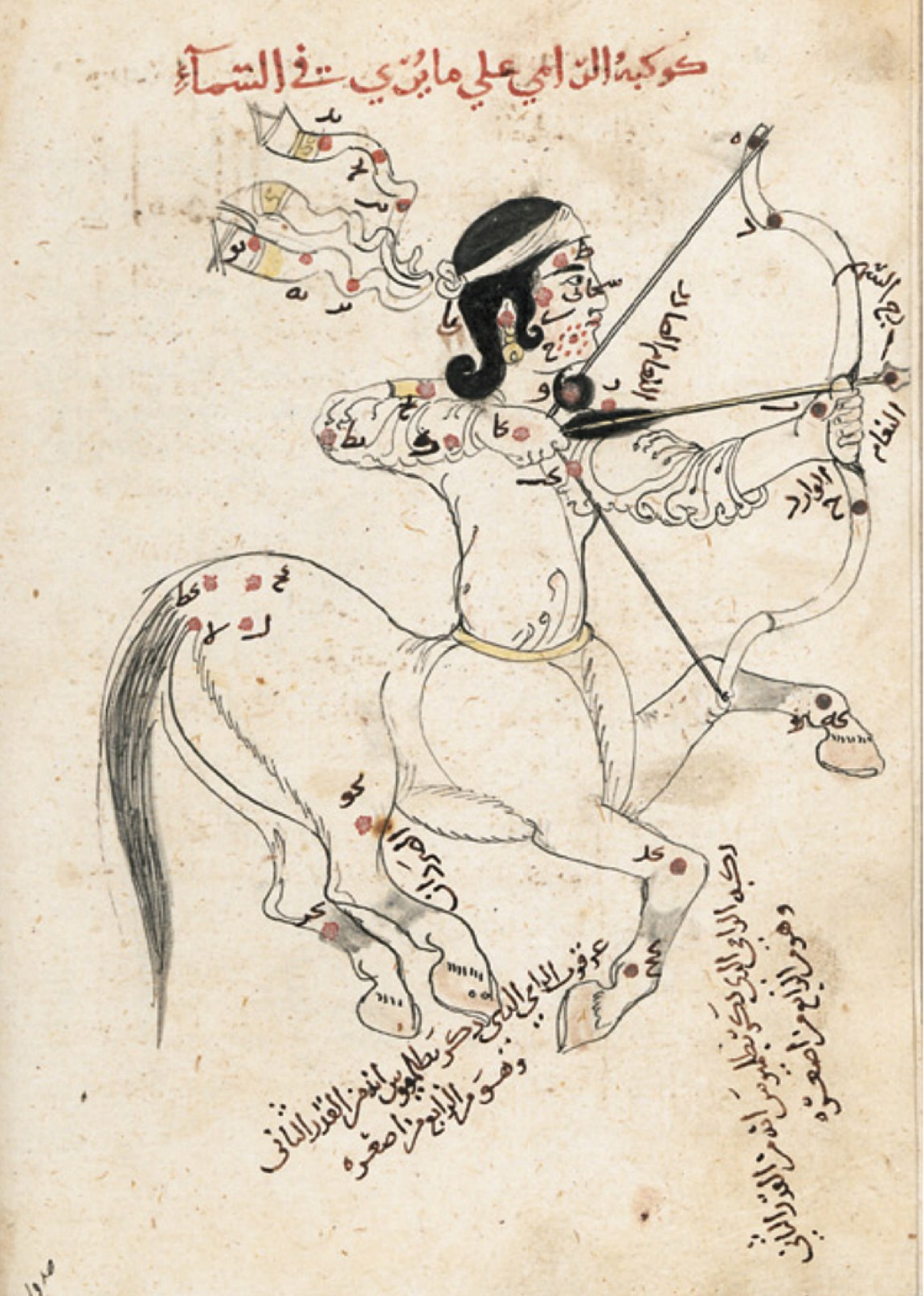
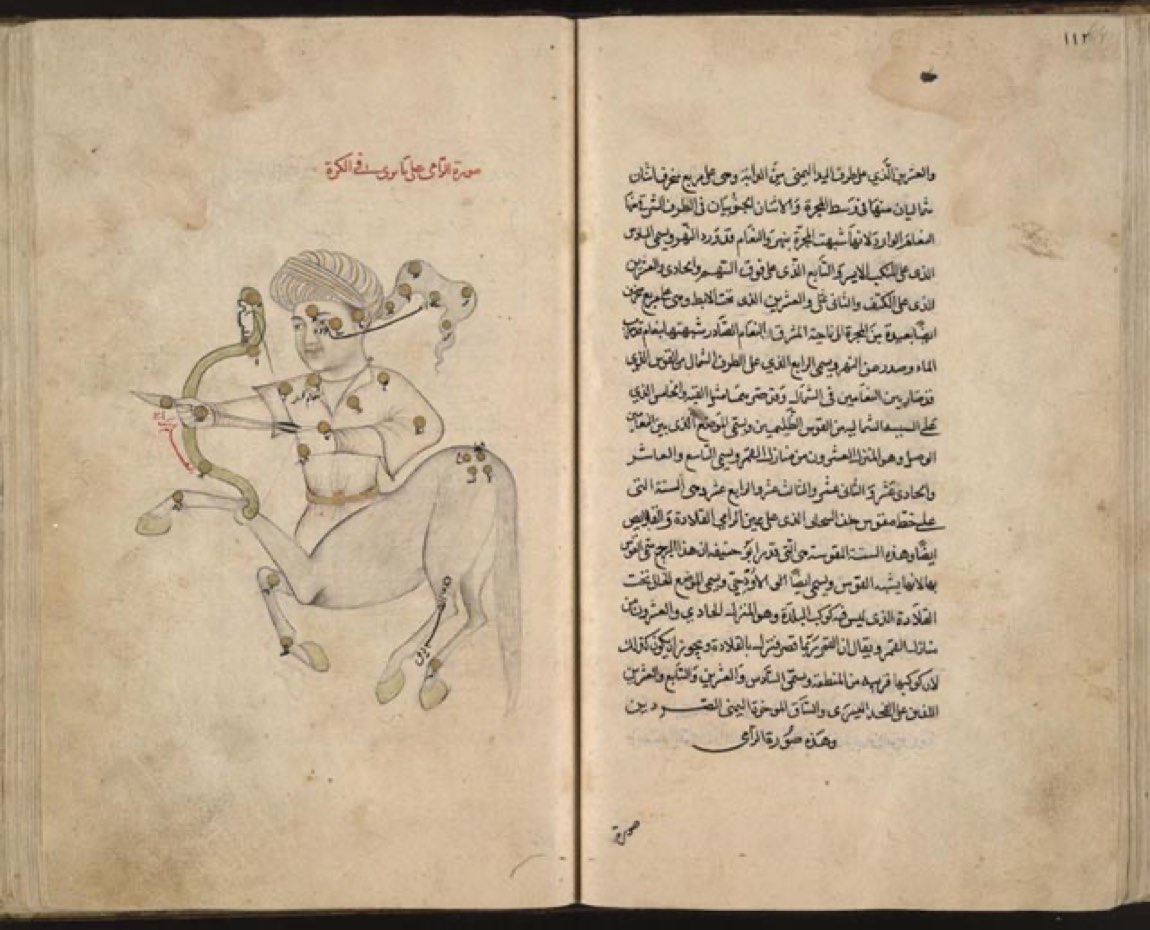
Completed and published in 964, Kitab suwar al-kawakib — The Book of Fixed Stars — was dedicated to Adud al-Dawla, the Buwayhid ruler, a gesture that acknowledged both patronage and political reality. The book catalogued 48 constellations and provided, for each star within them, a striking array of data: longitudinal and latitudinal coordinates, magnitude, and position relative to the ecliptic. Al-Sufi also recorded the individual names and numbers of stars in every constellation. One of the book's most distinctive features was its illustration strategy: each constellation received two drawings, one showing the stars as they appear on the outside of a celestial globe, and a second showing the view as a person standing on Earth would see them looking up — mirror images of each other, both necessary for practical use. The constellations were organized into three groups: 21 northern, 15 southern, and the 12 zodiac figures.
05 Accounting for Eight Centuries of Drift Deeper
The Almagest had been written roughly eight centuries before al-Sufi completed his own star catalogue, and in that span of time the slow wobble of Earth's axis — precession — had shifted the measured longitudes of every star relative to the coordinate grid anchored to the ecliptic. Rather than re-derive each position from scratch, al-Sufi applied a uniform correction: he added 12 degrees and 42 arcminutes to every longitudinal value Ptolemy had recorded. This adjustment brought the ancient positions forward to his own observational era. The precision of that figure — not a round 12 or 13 degrees, but 12° 42' — reflects a careful attempt to match theory to observation. Al-Sufi also identified stars that Ptolemy had omitted from his catalogue entirely and described them in his text, but he made a deliberate methodological choice not to include them in his own star charts, explaining that since his charts were modelled on Ptolemy's, he would preserve the same boundaries.
06 The Earliest Written Glimpse of Andromeda
In 964 — the same year The Book of Fixed Stars was completed — al-Sufi recorded what would become the earliest known written observation of the Andromeda Galaxy, describing the object as a "small cloud." That spare phrase is historically enormous: it marks the first time any galaxy beyond the Milky Way appeared in a written astronomical record. The description was purely observational; al-Sufi had no way of knowing the nature of what he was seeing, and the concept of external galaxies lay nearly a thousand years in the future. His record demonstrates that naked-eye astronomy, practiced with sufficient care and attention, could detect objects at cosmic scales. A separate claim — that al-Sufi also identified the Large Magellanic Cloud — appears to be a misunderstanding. The article in question seems to refer to stars south of Canopus that al-Sufi himself admitted he had not directly observed, not a recorded sighting of the Cloud.
 ⤢
⤢
07 Over a Thousand Uses for the Astrolabe
Beyond his star catalogue, al-Sufi produced a substantial treatise on the astrolabe, the elegantly engineered analog instrument used throughout the medieval Islamic world. According to American Near Eastern scholar Adam L. Bean, al-Sufi's text described more than 1,000 distinct uses for the device — a figure that itself tells a story about the instrument's centrality to daily and scholarly life. His catalogued applications ranged across astronomy, astrology and horoscope casting, maritime and overland navigation, land surveying, timekeeping, determining the direction of the Qibla (the direction of Mecca for Muslim prayer), and the scheduling of Salat, the five daily prayers. The breadth of that list illustrates how in medieval Islamic civilization, a single precision instrument could serve simultaneously as scientific tool, religious aid, and practical navigational device — disciplines that modern practice treats as entirely separate domains.
08 Surviving Manuscripts and Their Imperfections Deeper
Thirty-five copies of The Book of Fixed Stars are known to survive, a relatively generous manuscript tradition for a medieval scientific work. But survival came with degradation: scribal errors accumulated as copyists reproduced the text by hand across generations, and the magnitude value assigned to a particular star can vary from one manuscript copy to another. This textual instability creates genuine difficulty for historians trying to reconstruct al-Sufi's original measurements. The problem is compounded by the already noted absence of any explanation in the surviving texts for how al-Sufi actually determined his magnitude values. Scholars must work across manuscript variants, comparing them to identify where numbers diverged and which versions are most likely to reflect the original. Despite the work's recognized importance, a first partial English translation did not appear until 2010 — more than 1,000 years after the book was completed, a remarkable gap that reflects both the difficulty of the text and the relatively late engagement of English-language scholarship with classical Arabic astronomy.
09 Ulugh Beg and the Long Reach of the Catalogue
The influence of The Book of Fixed Stars extended well beyond al-Sufi's own lifetime and court. Among the astronomers who drew on his work was Ulugh Beg, who was at once a Timurid prince and a serious practicing astronomer — one of the more unusual combinations in the history of science. The fact that a royal astronomer of Ulugh Beg's stature and resources found al-Sufi's catalogue useful speaks to its enduring accuracy and organizational value. Al-Sufi thus occupied a position in the transmission chain of astronomical knowledge: he received and refined the Ptolemaic tradition, and that refined version was passed forward to later Islamic astronomers who extended it further. This relay structure — each generation correcting and building on the last — was how pre-telescopic astronomy advanced, and al-Sufi was a significant link in it.
10 Named in Stone, Sky, and Software
Al-Sufi's legacy has been formally inscribed in multiple places. A lunar crater carries the Latinized form of his name, Azophi, granting him a permanent presence on the Moon's surface. The minor planet 12621 Alsufi is named in his honor, placing his name in the asteroid belt between Mars and Jupiter. On Earth, the Astronomy Society of Iran's Amateur Committee established international Sufi Observing Competitions in his memory: the first was held in 2006 in the north of Semnan Province, the second in the summer of 2008 near Ladiz, close to Zahedan, and together the two events drew more than 100 participants from Iran and Iraq. In the digital era, Google marked what would have been al-Sufi's 1,113th birthday with a Google Doodle on 7 December 2016, briefly introducing him to an audience measured in millions — the modern equivalent of the royal dedication that opened his most famous book.