Virgin Galactic
Company · United States · founded 2004
The space-tourism pioneer with the winged approach: a carrier aircraft releases a rocket plane that coasts above 80 km, giving passengers minutes of weightlessness and the curve of the Earth. After years of development tragedy and triumph, it flew paying customers in 2023–24, then stood down to build its next-generation Delta fleet — see News for current status.
✦ Highlights
- First tourism spaceplane flights
- Spaceport America operations
The deep dive
Researched for the Atlas from Wikipedia — Virgin Galactic (33,376 characters read) · updated Sep 20, 2026
01 From X Prize to a Company's Founding
Virgin Galactic's origins trace directly to a single dramatic competition. The Ansari X Prize, created in May 1996, offered US$10,000,000 to the first non-government organization to launch a reusable crewed spacecraft into space twice within two weeks. The prize was renamed on 6 May 2004 after a multimillion-dollar donation from entrepreneurs Anousheh Ansari and Amir Ansari. It was won on 4 October 2004 — the 47th anniversary of the Sputnik 1 launch — by Burt Rutan's Tier One project, financed by Microsoft co-founder Paul Allen, using the experimental spaceplane SpaceShipOne. That single $10 million prize catalyzed more than $100 million in new technologies across competing teams. Richard Branson, who had already built the Virgin Group and Virgin Atlantic airline and had a personal record of balloon and surface record-breaking, saw the technology's commercial potential immediately. He founded Virgin Galactic in 2004, just as the prize was being claimed, to turn Rutan's proof-of-concept into a paying passenger business. The Spaceship Company was then established in 2005, with Virgin Group owning 70% and Burt Rutan's Scaled Composites owning 30%, to actually build the vehicles.
02 How the Air-Launch System Actually Works
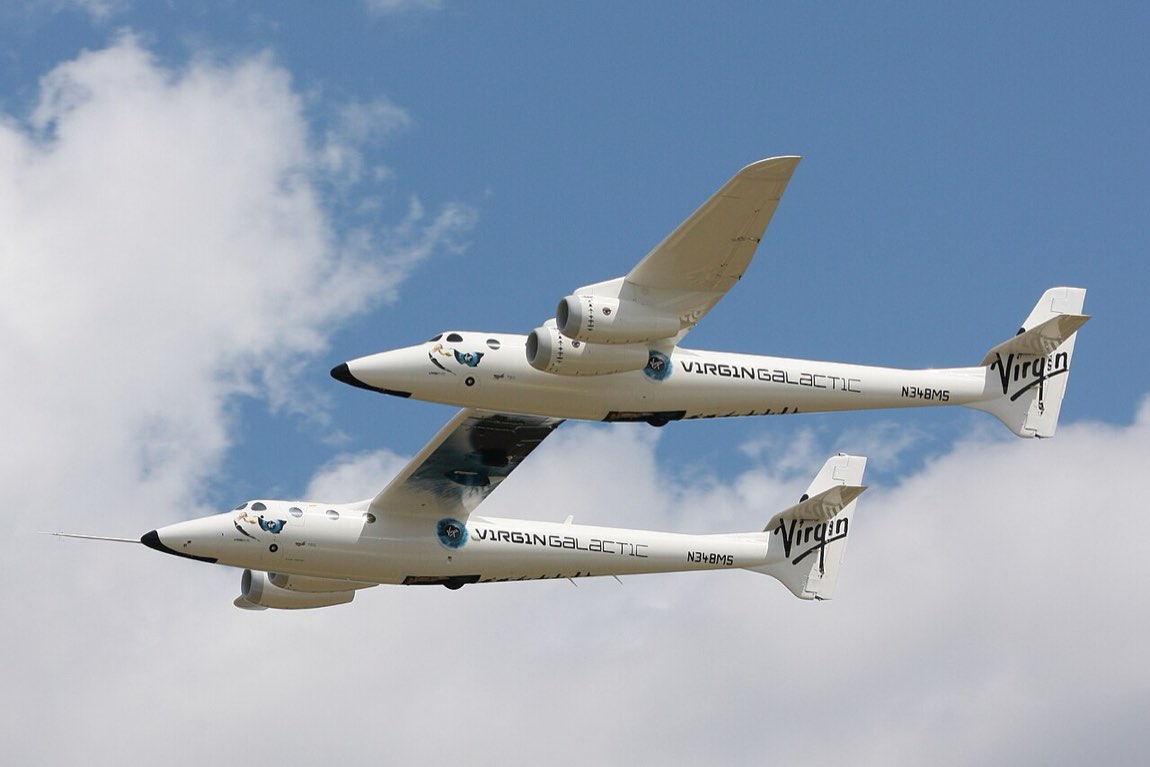
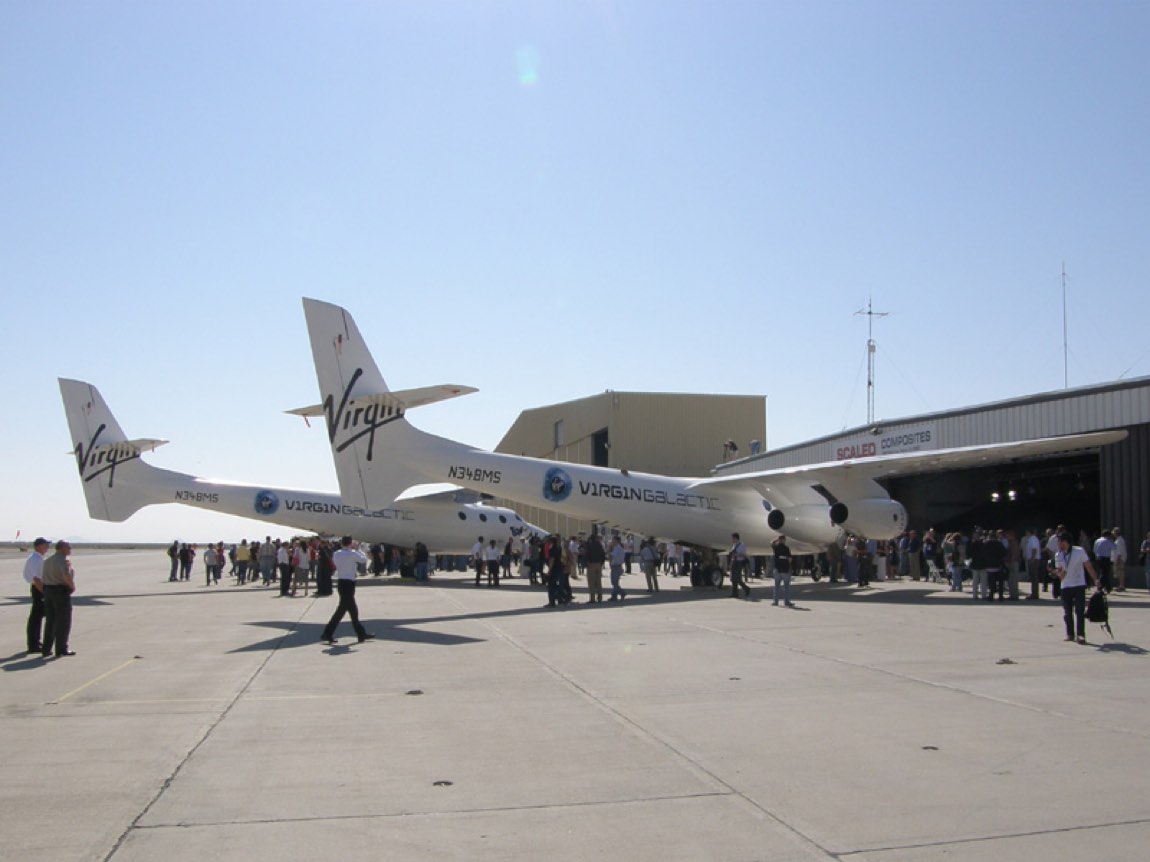
Virgin Galactic's vehicles never lift off from a runway under rocket power alone. Instead, a large twin-hulled carrier aircraft called White Knight Two carries the spaceplane slung beneath its central wing section to a release altitude of around 44,000 feet — roughly 13 kilometers — before dropping it. After separation, the spaceplane ignites its hybrid rocket motor and climbs steeply toward space on its own. The original SpaceShipTwo was designed to reach above 100 km, the Kármán line, though VSS Unity's flights have peaked at 89.9 km. The full mission from White Knight Two liftoff to spaceplane landing was planned to take about 2.5 hours, but the rocket-powered suborbital arc itself is only a brief fraction of that time. Passengers were designed to experience approximately 6 minutes of weightlessness, during which they could unstrap and float freely in the cabin. To reenter the atmosphere safely, SpaceShipTwo uses a distinctive feathering system: the tail section pivots upward, creating high drag and a stable, shuttlecock-like descent that requires no pilot input to maintain orientation, before the wings are returned to position for an unpowered glide landing. This feather mechanism would later prove critical to understanding the 2014 accident.
03 The Deadly Accidents That Shaped Safety Culture Deeper
Two catastrophic events left permanent marks on Virgin Galactic's engineering and safety philosophy. The first came in July 2007, when three Scaled Composites employees — Todd Ivens, Eric Blackwell, and Charles May — were killed at the Mojave spaceport during a cold fire test of the SpaceShipTwo rocket motor. The test involved nitrous oxide flowing through fuel injectors and had been considered safe; the workers were standing behind a chain-link fence that offered no real protection when a tank exploded. The cause was never made public, and the company was fined for health and safety violations. The second disaster struck on 31 October 2014, when VSS Enterprise broke apart in mid-air during its fourth rocket-powered test flight. Co-pilot Michael Alsbury, 39, was killed; pilot Peter Siebold, 43, was seriously injured. The NTSB determined that Alsbury had prematurely unlocked the feather tail system just ten seconds after engine ignition while the craft was breaking the sound barrier at Mach 1, when it was designed to unlock only above Mach 1.4. Critically, Scaled Composites had not built a fail-safe to prevent premature unlocking, and the NTSB emphasized that human factors were never adequately incorporated into the design. These findings drove Virgin Galactic to add an automatic mechanical inhibit device to the successor vehicle and to adopt formalized crew resource management procedures.
04 VSS Unity's Long Road Back to Space
Following the Enterprise crash, the replacement vehicle VSS Unity was publicly rolled out on 19 February 2016. Its return to flight was methodical: captive carry flights under White Knight Two began in September 2016, and the first free glide test — a ten-minute unpowered descent — was completed in December 2016. Seven glide tests followed before the first powered flight since 2014 took place on 5 April 2018. Progress then accelerated. By July 2018, Unity had surpassed its predecessor's performance. On 13 December 2018, Unity reached 82.7 km altitude at speeds close to three times the speed of sound, earning its two pilots, Mark Stucky and Frederick Sturckow, commercial astronaut wings from the US government. A February 2019 flight carried a passenger for the first time, reaching 89.9 km. After Unity transferred to Spaceport America in New Mexico in February 2020, COVID-19 cases forced postponements, and a December 2020 attempt was scrubbed by a computer connection problem that prevented engine ignition. The spacecraft eventually reached its peak altitude of 89.9 km on a May 2021 flight — the first human spaceflight ever launched from New Mexico — before completing the full crewed test flight carrying Richard Branson in July 2021.
 ⤢
⤢
05 Richard Branson's 2021 Flight and Its Complications
The 11 July 2021 flight of VSS Unity, designated Unity 22, carried founder Richard Branson alongside employees Beth Moses, Colin Bennett, and Sirisha Bandla as passengers, with pilots Dave Mackay and Michael Masucci at the controls. It made Virgin Galactic the first spaceflight company to independently launch its own founder into space using the US definition of 50 miles. The six on board experienced approximately three minutes of weightlessness above Earth's atmosphere during a mission that lasted roughly one hour in total, taking off and landing at Spaceport America near Truth or Consequences, New Mexico. The timing of the flight was notable: it had originally been scheduled for later in the summer, but was moved forward shortly after competitor Blue Origin announced plans to fly Amazon founder Jeff Bezos on 20 July 2021. Despite initial celebration, the flight was later revealed to have a significant problem: Unity briefly flew outside the airspace that had been reserved for the mission, and the FAA was not informed as required by procedure. The FAA grounded Virgin Galactic's spacecraft until the company revised its procedures, including reserving a larger volume of airspace for future flights.
06 Ticket Prices and the Commercial Market
The evolution of Virgin Galactic's ticket pricing reveals how the economics of space tourism shifted over two decades. Early reservation holders at the December 2009 SpaceShipTwo unveiling had booked at $200,000 per seat, and Branson spoke to the 300 people in attendance about flights beginning in 2011. By May 2013, the price had already risen to $250,000, and by August 2013, 640 customers had signed up. The company collected $80 million in fares and deposits from those early reservations. After the 2014 crash and years of delays, Virgin resumed public ticket sales in February 2022 at $450,000 per seat. The first commercial flight, Galactic 01 on 29 June 2023, was a 70-minute mission purchased by the Italian Air Force and the Italian National Research Council with three outside passengers aboard. At the time, roughly 800 individuals had bought tickets for Unity flights. By February 2025, a seat was estimated to cost about $600,000. In 2026, after pausing Unity operations entirely, the company resumed accepting reservations, this time requiring a $1,000 deposit toward a ticket price of $750,000 — nearly four times the original 2009 price.
07 Spaceport America and the New Mexico Investment
Virgin Galactic's commercial home base is Spaceport America, a purpose-built facility in southern New Mexico near Truth or Consequences. Its 3,000-meter (10,000-foot) runway was opened in October 2010, and SpaceShipTwo VSS Enterprise was shipped to the site carried under Mothership Eve for the occasion. The New Mexico state government invested approximately $200 million (£121 million) in the facility, with Virgin Galactic as anchor tenant. The spaceport's striking terminal building, designed through an international architectural competition, was awarded to URS and Foster + Partners architects. Virgin Galactic transferred VSS Unity from California to Spaceport America in February 2020, making New Mexico the base for all subsequent crewed flights. The May 2021 powered test flight marked the first human spaceflight ever launched from the state. The facility is not exclusively Virgin Galactic's — other commercial space companies also use the site — but Virgin's presence as anchor tenant underpinned the state's rationale for the substantial public investment. The design of Spaceport America was built to accommodate a global launch network that Virgin Galactic had envisioned, with additional spaceports once planned in Abu Dhabi and potentially in Sweden and Scotland, though those international expansions did not materialize.
08 Years of Delays and Repeated Missed Deadlines Deeper
Few aspects of Virgin Galactic's history are as documented as the persistent gap between announced launch dates and reality. In July 2008, Branson predicted a maiden space voyage within 18 months. In October 2009, the company promised initial flights from Spaceport America within two years. At the December 2009 unveiling, he told paying customers flights would begin in 2011. In April 2011, he pushed that estimate to 18 months out. A May 2013 radio appearance named Christmas Day 2013. In September 2014, he cited February or March 2015. By October 2014, the craft had only reached about 71,000 feet — roughly 13 miles — in testing, far short of the 62-mile altitude needed for an FAA passenger license. Virgin Galactic CEO George Whitesides acknowledged in 2014 that when he joined in 2010, the company was primarily a marketing organization, only later developing genuine in-house capability to design, build, test, and fly rocket motors. The Wall Street Journal described internal tension between Branson's optimism and technical realities. The NTSB crash investigation later revealed that test flights were conducted without adequate safety analysis of human error scenarios, suggesting that schedule pressure may have contributed to the conditions leading to the 2014 disaster.
 ⤢
⤢
09 LauncherOne, Virgin Orbit, and a Spinoff's End Deeper
Beginning in 2008, Virgin Galactic developed LauncherOne alongside its passenger business — an expendable, two-stage, liquid-fueled rocket designed to air-launch small satellite payloads of up to 200 kilograms into Earth orbit. The configuration was similar in concept to Orbital Sciences' Pegasus. It was publicly announced in July 2012, and by June 2015 the company had signed a contract with OneWeb Ltd. for 39 satellite launches with options for 100 more. In 2015, Virgin established a 150,000-square-foot research, development, and manufacturing center for LauncherOne at Long Beach Airport. Rather than using White Knight Two as the carrier, the system eventually switched to a Boeing 747-400 aircraft called Spirit of Mojave, acquired from Virgin Atlantic. In March 2017, the entire LauncherOne business — including its 200-member team — was spun off into a new company called Virgin Orbit. Virgin Orbit executed a handful of orbital launches before filing for bankruptcy in 2023 and ceasing operations entirely. The OneWeb satellite constellation that had been a major launch customer ultimately had to find other providers. The Boeing 747 and the LauncherOne business left Virgin Galactic's fleet and balance sheet with the 2017 spinoff, leaving the parent company to focus solely on suborbital human spaceflight.
10 SpaceShipTwo's Design Heritage and Specifications Deeper
SpaceShipTwo was built as a scaled-up successor to SpaceShipOne, the Ansari X Prize winner. Where SpaceShipOne could carry a single pilot and two passengers, SpaceShipTwo was designed for a crew of two pilots and six passengers, measuring 18 meters (60 feet) in length — twice the size of its predecessor. The spacecraft was constructed from lightweight carbon-composite materials and powered by a hybrid rocket motor. It was originally designed to reach 110 km, exceeding the 100 km Kármán line to lengthen passengers' weightlessness experience, with a top speed of 4,000 km/h (2,485 mph). The initial propellant was a rubber-based solid fuel developed by Sierra Nevada Corporation, but Virgin announced in May 2014 that this motor had been abandoned after it failed to meet expectations — notably, SNC also abandoned the motor for their Dream Chaser vehicle in July 2014. The replacement used a polyamide grain. Early rocket-powered tests revealed significant performance gaps: the first test in April 2013 achieved only Mach 1.2 and reached 55,000 feet, far below targets, and the second supersonic test achieved 1,100 mph for 20 seconds, against a requirement of 2,500 mph for 70 seconds to reach space with passengers. Unity's actual maximum recorded altitude reached in testing was 89.9 km.
11 Delta-Class Vehicles and Future Direction
After VSS Unity completed its final flight, Galactic 07, in mid-2024, Virgin Galactic deliberately halted Unity operations to concentrate resources on its third-generation spacecraft. The Delta-class vehicles are functionally equivalent to the SpaceShip III design — itself an evolved version of SpaceShipTwo — but have been redesigned from the ground up for higher production volumes and a greater launch cadence. Virgin Galactic planned to have Delta-class vehicles ready for testing in 2025 and in commercial service by 2026. The Delta class requires a new mothership as well. Virgin announced in July 2022 a partnership with Boeing's Aurora Flight Sciences division to design and build the next-generation carrier aircraft. That partnership ran into difficulties: Boeing ended work on the contract in 2023 and filed suit against Virgin Galactic over unpaid bills, though the lawsuit was settled in 2024. SpaceShip III, the intermediate design step, was cancelled entirely in 2024 with no vehicles of that class ever completed or flown. The company also announced in September 2025 a partnership with Purdue University for a dedicated suborbital research flight called Purdue 1, planned for 2027, with a five-person crew of Purdue faculty, students, and alumni conducting experiments in quantum technology, in-space chip manufacturing, and zero-gravity liquid dynamics.
12 Funding, Investors, and Going Public Deeper
Virgin Galactic has drawn investment from a diverse set of sources since its founding. Virgin Group claimed an initial investment of US$100 million in the company. In 2010, the Abu Dhabi sovereign wealth fund Aabar Investments acquired a 31.8% stake for US$280 million, receiving exclusive regional rights for launch tourism and scientific research flights from the United Arab Emirates capital. In July 2011, Aabar invested a further US$110 million to support a small satellite launch program, raising its equity share to 37.8%. The New Mexico state government separately invested approximately $200 million in Spaceport America. On 28 October 2019, Virgin Galactic became the first publicly traded space tourism company when it listed on the New York Stock Exchange under the ticker symbol SPCE, raising $450 million through a SPAC merger. Its market value immediately after listing exceeded $2.4 billion. At that time, the company reported over 600 customer reservations, representing approximately $80 million in collected deposits and more than $120 million in potential revenue. By 2026, Virgin Investments Limited — the Virgin Group vehicle — retained an 11.9% stake in the company, a substantially reduced share reflecting the equity dilutions and transactions of the intervening years.