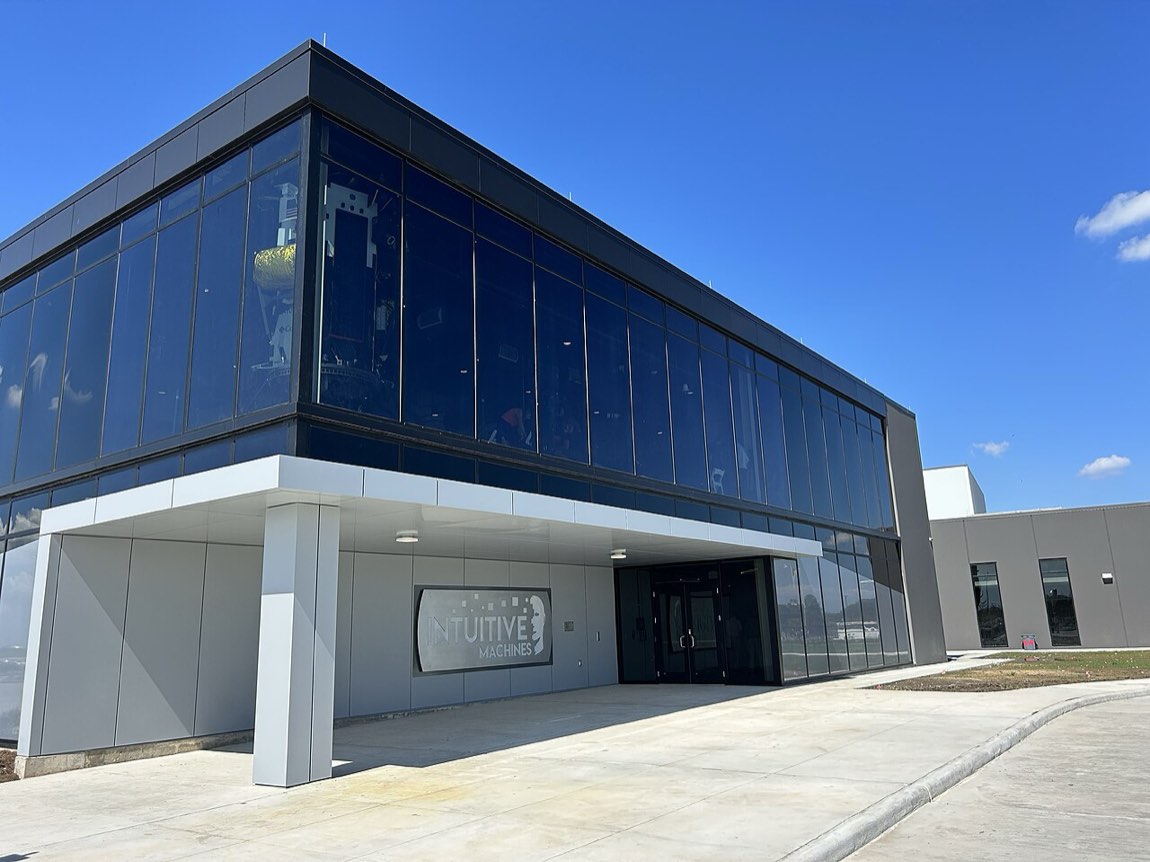
Intuitive Machines
Company · United States · founded 2013
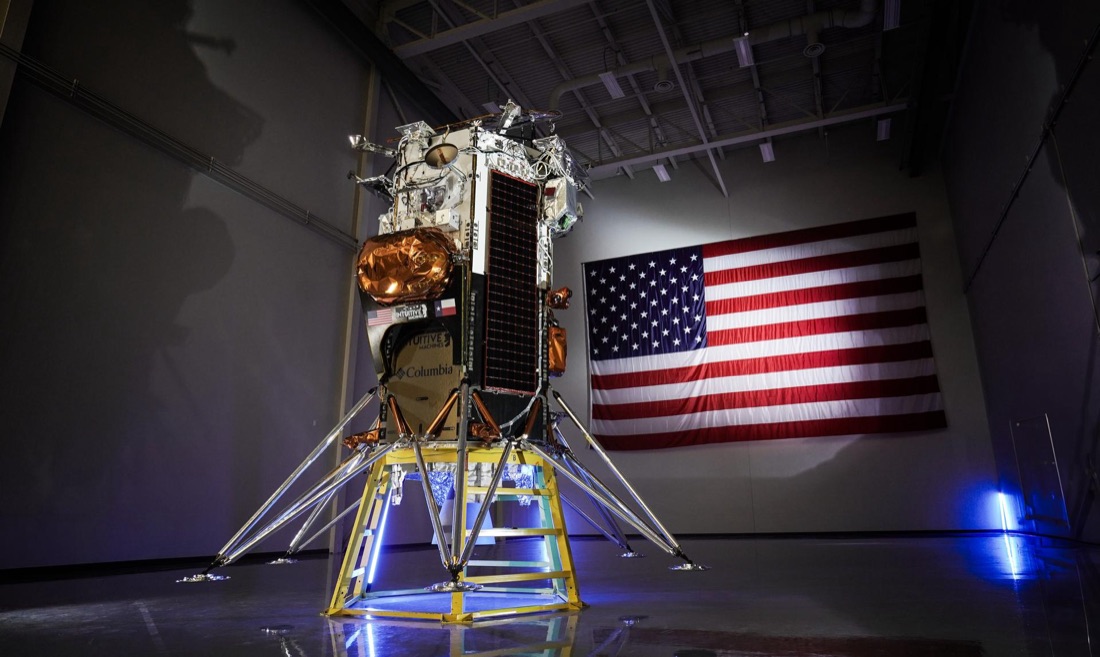
The first company to put American hardware on the Moon since 1972. Odysseus landed near the south pole in February 2024 — snapping a leg and leaning, but transmitting. A second lander (2025) also tipped. The lesson both ways: commercial lunar delivery works, and the Moon punishes everyone's landing gear.
✦ Highlights
- Odysseus south-pole landing (2024)
- NASA CLPS contracts
- Lunar comms network plans
The deep dive
Researched for the Atlas from Wikipedia — Intuitive Machines (8,400 characters read) · updated Sep 20, 2026
01 Founding Vision and the Three Founders
Intuitive Machines was established in 2013 by three people whose backgrounds pointed directly at the Moon: Stephen Altemus, Kam Ghaffarian, and Tim Crain. Their stated purpose from the outset was to enable both commercial and government exploration of the lunar surface — not as a distant aspiration but as a near-term business model. The company is incorporated in Delaware and headquartered in Houston, Texas, placing it squarely within the broader aerospace corridor that grew up around NASA's Johnson Space Center. Crain, who would become the company's CTO, brought direct heritage from NASA's Project Morpheus, a landing test vehicle development effort that began in 2010 and served as a conceptual ancestor of what would eventually become the Nova-C lander. That lineage meant Intuitive Machines was not starting from scratch — it was translating government-funded research into a commercial product, a pattern that would define much of its early identity.
02 How Intuitive Machines Defines Lunar Commerce
Rather than focusing on a single product, Intuitive Machines organizes its business around three interlocking pillars it describes as the foundation of a lunar economy. The first is transportation and payload delivery — getting satellites, scientific instruments, and cargo to the lunar surface, including rideshare arrangements that let multiple customers share a single flight. The second is data: the collection, processing, and interpretation of space-based information through command, control, communications, reconnaissance, and prospecting. The third pillar is infrastructure on the lunar surface itself, including autonomous systems capable of performing navigation, maintenance, scientific data collection, and system health monitoring without continuous human direction. Together these pillars represent the company's argument that the Moon is not just a destination for flags and footprints but a place where persistent, self-sustaining commercial activity can eventually take root. NASA's repeated selection of the company for task orders through its Commercial Lunar Payload Services initiative — five awards in total — suggests at least one major customer finds the argument credible.
 ⤢
⤢
03 The Nova-C Lander: From Contract to Flight
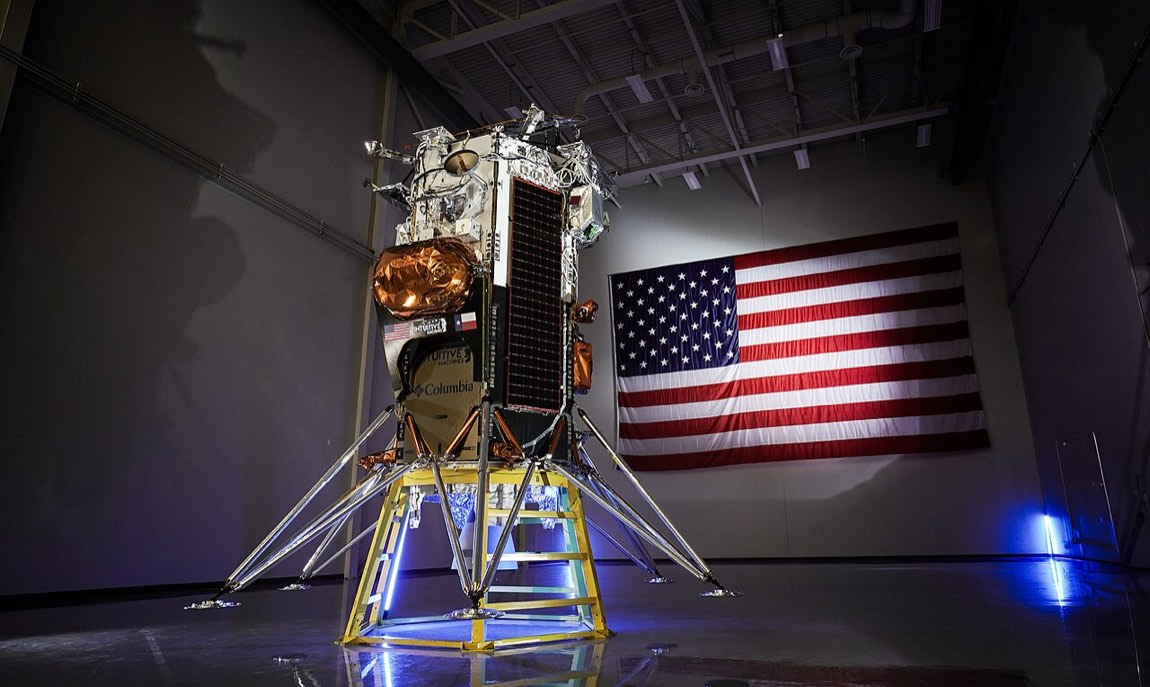
The Nova-C lander sits at the center of Intuitive Machines' transportation business. In November 2018, NASA selected the company as one of nine firms eligible to bid on the Commercial Lunar Payload Services program, and on May 31, 2019, the agency awarded Intuitive Machines $77 million specifically to build and launch the Nova-C. Early mission planning named a deep, narrow valley called Vallis Schröteri as a target, and the objective was refined to place the lander at crater Malapert A, near the Moon's south pole — a region of intense scientific interest because of its potential water-ice deposits and near-continuous sunlight on certain ridgelines. Nova-C was NASA CLPS's first mission of the program. The lander carried five NASA science instruments on its first flight along with several commercial payloads, one of which was sponsored by Columbia Sportswear. The seven-day transit to the Moon gave engineers a chance to validate systems before the high-stakes landing sequence.
04 IM-1 Odysseus: A Historic but Imperfect Landing
On February 22, 2024, the Odysseus lander touched down on the lunar surface — and immediately tipped over. The spacecraft fell on its side, sharply limiting its ability to communicate and receive sunlight for power, and it received only minimal data from its science payloads before losing communications entirely. The lander survived a total of six days on the surface. Despite failing to meet many of its mission objectives, Odysseus holds a genuine historical distinction: it was the first American spacecraft to land on the Moon since the Apollo program, a gap of more than five decades. NASA and Intuitive Machines both judged the mission a partial success, partly because the instruments remained at least partially functional even in the tipped configuration, and the reduced downlink capacity still returned some data. Most independent industry experts agreed with that cautious assessment. The mission demonstrated that a commercial company could reach the lunar surface — but also exposed the razor-thin margins involved in autonomous precision landing.
 ⤢
⤢
05 IM-2 Athena: The Same Failure, Twice Deeper
Athena launched on February 27, 2025, carrying the Micro-Nova Gracie hopper, additional rovers, and payloads designed to validate water-hunting infrastructure including a drill. The hopper was engineered to detach from the lander and prospect by jumping across the lunar surface — an innovative mobility concept suited to the rough terrain near the poles. Athena achieved a soft landing on March 6, 2025, but once again the lander came to rest on its side. Operations concluded on March 7, 2025, less than 13 hours after touchdown. On March 13, Intuitive Machines disclosed the root cause: the lander's laser altimeter had failed during descent, exactly as it had on IM-1, leaving the onboard computer without an accurate altitude reading. Without that data, the spacecraft struck a plateau, tipped, and skidded across the surface, rolling once or twice before settling inside a crater. The CEO compared the motion to a baseball player sliding into a base. Regolith kicked up by the impact coated the solar panels, further degrading power generation. The back-to-back altimeter failures raised pointed questions about whether the underlying sensor design had been adequately addressed between missions.
06 The Altimeter Problem: What Went Wrong Twice Deeper
The laser altimeter is a critical sensor in any powered-descent sequence: it measures the distance between the spacecraft and the ground in real time, allowing the flight computer to throttle engines and adjust attitude for a controlled touchdown. On both IM-1 Odysseus and IM-2 Athena, this sensor failed during the landing phase, leaving the autopilot essentially blind to its true altitude. The consequence in both cases was the same — the lander contacted the surface at an unexpected moment and angle, causing it to tip rather than stand upright. On Athena, the failure was compounded by terrain: the spacecraft struck a plateau it could not see coming, then tumbled into a crater. Intuitive Machines did not publicly detail between the two missions exactly what corrective action, if any, had been taken on the altimeter system. The repetition of the identical failure mode in successive missions is the most significant technical question the company faces as it prepares IM-3 and beyond. Understanding whether this is a sensor-hardware issue, a software-integration issue, or a testing-environment gap will be essential before the pattern can be broken.
 ⤢
⤢
07 Building a Relay Network Around the Moon
Beyond landing spacecraft, Intuitive Machines is constructing what it describes as a communications and navigation backbone for lunar operations. In September 2024, the company became the sole awardee of NASA's Near Space Network Services contract for relay services — a significant win that gives it responsibility for providing communication and navigation support to Moon-based missions operated by a range of customers. The plan calls for a constellation of five data relay satellites deployed incrementally. The first satellite is scheduled to launch aboard IM-3, which is currently undergoing integrated vibration testing with a mission window anticipated in early 2026. Two more relay satellites are planned for IM-4. If the full constellation is eventually deployed, Intuitive Machines would operate infrastructure that any lunar mission — whether NASA's, a foreign agency's, or a private company's — could use for continuous contact with Earth, much as communications satellites provide global coverage from geostationary orbit today.
08 International Science Aboard Future Missions
The manifest for Intuitive Machines' upcoming flights reads like a small international consortium. IM-4 will carry six NASA CLPS payloads, among them the Prospect drill suite led by the European Space Agency, which will search for water ice at the lunar south pole. IM-4 will also carry RISE, a regolith experiment provided by JAXA, the Japan Aerospace Exploration Agency. IM-5, the first mission to use the larger Nova-D lander rather than the Nova-C, is targeting Mons Malapert at the lunar south pole and will carry two rovers: the Australian Space Agency's Roo-ver and Honeybee Robotics' Lunar Rover. The Nova-D's greater cargo capacity means IM-5 will deliver significantly more mass to the surface than any previous Intuitive Machines mission. The involvement of ESA, JAXA, and the Australian Space Agency on a single American commercial provider's manifest illustrates how the CLPS model is quietly becoming a vehicle for international lunar science without the formal treaty structures of programs like Apollo or the International Space Station.
09 Going Public: The SPAC Route to Nasdaq
Intuitive Machines took an unconventional path to public markets. In September 2022, the company announced it would merge with Inflection Point Acquisition Corp., known by the ticker IPAX — a special-purpose acquisition company, or SPAC. SPACs raise money through an initial public offering and then search for a private company to acquire, effectively taking it public without a traditional IPO process. IPAX shareholders approved the deal on February 8, 2023, and the business combination closed six days later, on February 14, 2023. Intuitive Machines, Inc. began trading on the Nasdaq exchange that same day under the ticker symbol LUNR. The SPAC route was popular among space startups in the early 2020s because it offered faster access to capital markets with less regulatory friction than a conventional IPO, though it also attracted scrutiny over valuation practices. The company's subsequent announcement in November 2025 that it would acquire Lanteris Space Systems from Advent International for $800 million signals continued ambition to grow through acquisition as well as organic development.
10 Northrop Grumman Partnership and the Lunar Rover Effort
In 2021, Northrop Grumman announced a teaming arrangement that brought together Lunar Outpost, Intuitive Machines, and Michelin to design a Lunar Terrain Vehicle. The collaboration is notable for its industrial breadth: Northrop Grumman contributes its aerospace systems expertise, Michelin — better known for automobile tires — brings materials and wheel engineering relevant to traction on loose regolith, and Lunar Outpost focuses on rover development. Intuitive Machines' role connects naturally to its existing infrastructure and surface-access capabilities. The Lunar Terrain Vehicle program is connected to NASA's broader Artemis architecture, which envisions astronauts needing a pressurized or unpressurized rover to range across the lunar south pole region. The article does not specify the exact contract value or timeline for this vehicle, but the teaming announcement reflects how Intuitive Machines is positioning itself not merely as a delivery service but as a participant in the crewed lunar surface ecosystem.
11 KBR Joint Venture and Earth-Orbit Work Deeper
Not all of Intuitive Machines' revenue comes from the Moon. In April 2023, the company's joint venture with engineering firm KBR — called Space Networks Solution — was awarded a five-year contract worth up to $719 million to support NASA's Joint Polar Satellite System. The Joint Polar Satellite System operates in low Earth orbit and provides environmental monitoring data used in weather forecasting and climate science. This contract is structurally important for Intuitive Machines because it provides a significant, relatively predictable revenue stream that does not depend on the success of individual lunar landings. For a company whose lunar missions have so far produced two tipped landers, the stability of a multi-year Earth-orbit services contract offers a financial cushion. It also illustrates that the data-services pillar of the company's business model — collection, processing, and interpretation of space-based data — applies equally well to Earth-observing satellites as to lunar prospecting missions.