Blue Origin
Company · United States · founded 2000
Bezos's long-game space company: suborbital tourism flights since 2021, the heavy-lift New Glenn rocket (reached orbit on its January 2025 debut), BE-4 engines that also power ULA's Vulcan, and the Blue Moon lander chosen for NASA's second crewed Artemis landing. Its stated vision is millions of people living and working in space in orbital habitats.
✦ Highlights
- New Shepard tourism
- New Glenn orbital debut (2025)
- Blue Moon Artemis lander contract
The deep dive
Researched for the Atlas from Wikipedia — Blue Origin (32,617 characters read) · updated Sep 20, 2026
01 From Stealth Startup to Space Company
Blue Origin spent its first several years in near-total secrecy. Jeff Bezos, who had already built Amazon into a retail giant, founded the company in 2000 and funded it almost entirely through his own private investments. Rob Meyerson joined in 2003 and served as the effective leader before departing in 2018. The public learned almost nothing about what the company was doing during this period. The first concrete evidence of activity came in 2006, when Blue Origin purchased land 30 miles north of Van Horn, Texas, for what would become Launch Site One. That same November, the Goddard test rocket — a modest vehicle named after rocketry pioneer Robert Goddard — made its first flight, reaching just 285 feet before landing. It was a small hop by any measure, but it marked the company's first real step off the ground. This deliberate, incremental philosophy — testing simple systems before committing to complex ones — would define Blue Origin's development approach for the following two decades.
02 The Charon and Goddard Test Vehicles Deeper
Before Blue Origin ever fired a rocket engine under a flight vehicle, it flew something far stranger: a craft called Charon, named after Pluto's moon, powered by four Rolls-Royce Viper Mk. 301 jet engines mounted vertically. It was not a rocket at all, but a low-altitude testbed built specifically to validate the autonomous guidance and control software the company would later rely on. On March 5, 2005, Charon made its only flight at Moses Lake, Washington, climbing to 96 meters (316 feet) before landing near its liftoff point. As of 2016, the vehicle is on display at the Museum of Flight in Seattle. The follow-on Goddard vehicle, also called PM1, first flew on November 13, 2006, using Blue Origin's first rocket engine, the BE-1, which burned hydrogen peroxide propellant and produced 8.9 kN (2,000 lbf) of thrust. A planned December 2 follow-up flight never launched, though FAA records indicate two additional flights were eventually completed. These early vehicles show a company more interested in mastering control and processes than racing for altitude records.
 ⤢
⤢
03 The PM2 Crash and What Blue Origin Learned Deeper
Blue Origin's early test program was not without loss. A suborbital vehicle designated PM2 — likely short for Propulsion Module 2 — conducted two test flights in west Texas in 2011. The first, on May 6, was a low-altitude vertical takeoff and landing hop. The second, on August 24, ended in destruction. As PM2 accelerated through Mach 1.2 and climbed to 14 kilometers (46,000 feet), a flight instability drove the vehicle to an extreme angle of attack. This triggered the range safety system to terminate engine thrust, and the vehicle was lost. Blue Origin released a detailed failure analysis just nine days later, a relatively transparent move for an otherwise secretive company. PM2 was powered by five BE-2 engines, each a pump-fed bipropellant design burning kerosene and hydrogen peroxide, producing 140 kN (31,000 lbf) of thrust per engine. The failure underscored the genuine difficulty of controlled high-speed ascent and helped inform the more conservative, step-by-step test cadence the company applied to New Shepard development in the years that followed.
04 New Shepard: Engineering a Reusable Tourist Rocket
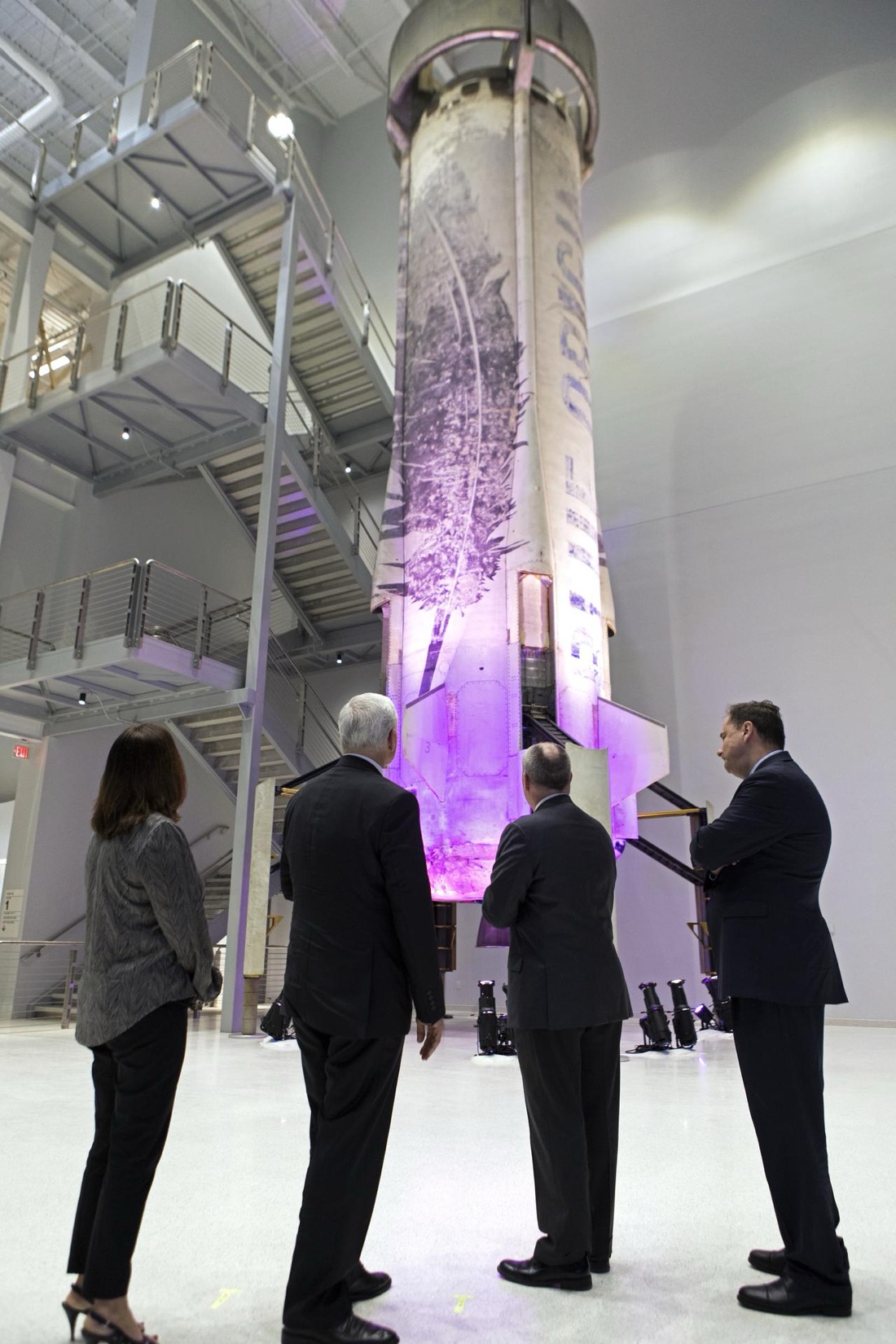
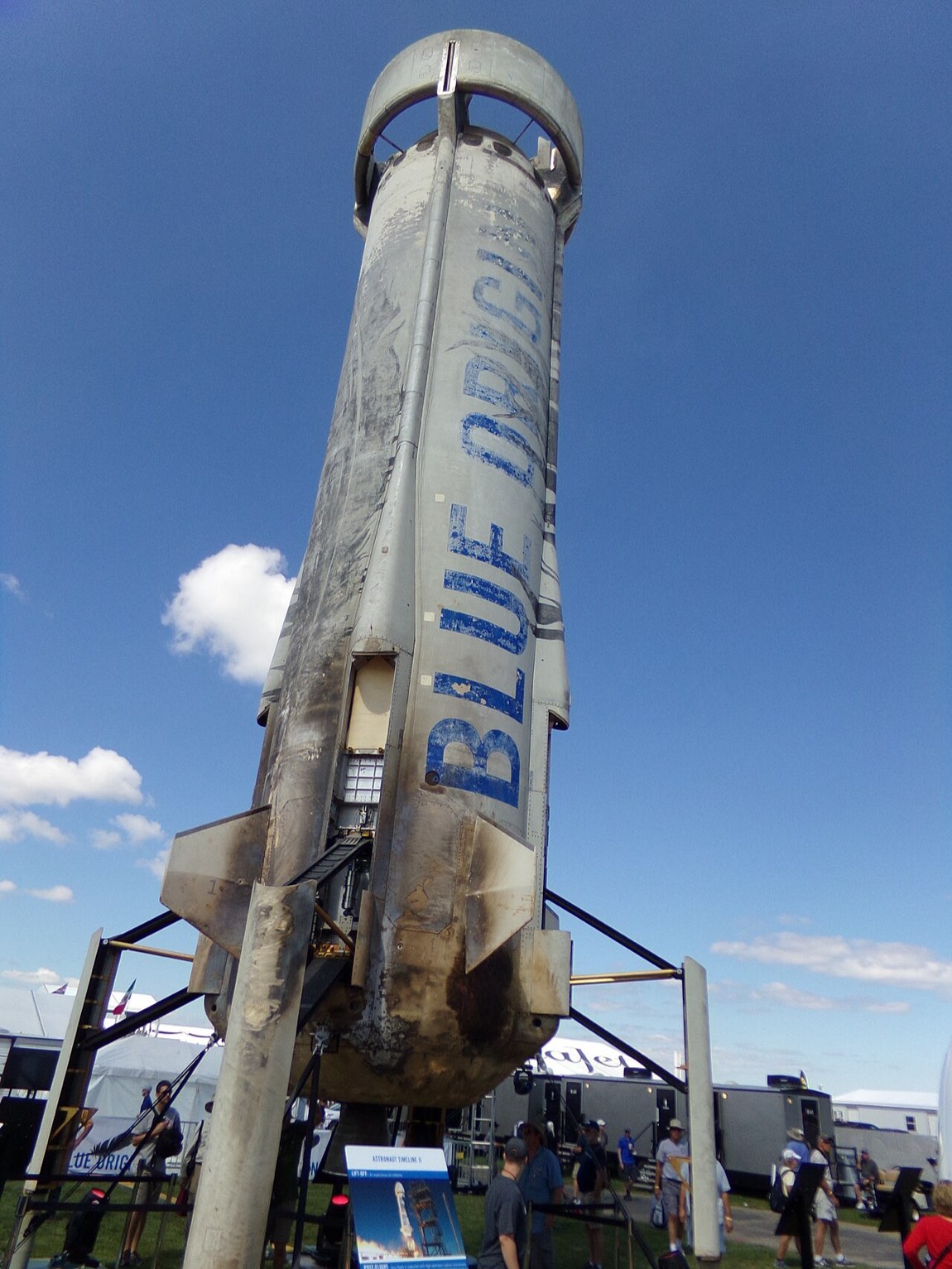
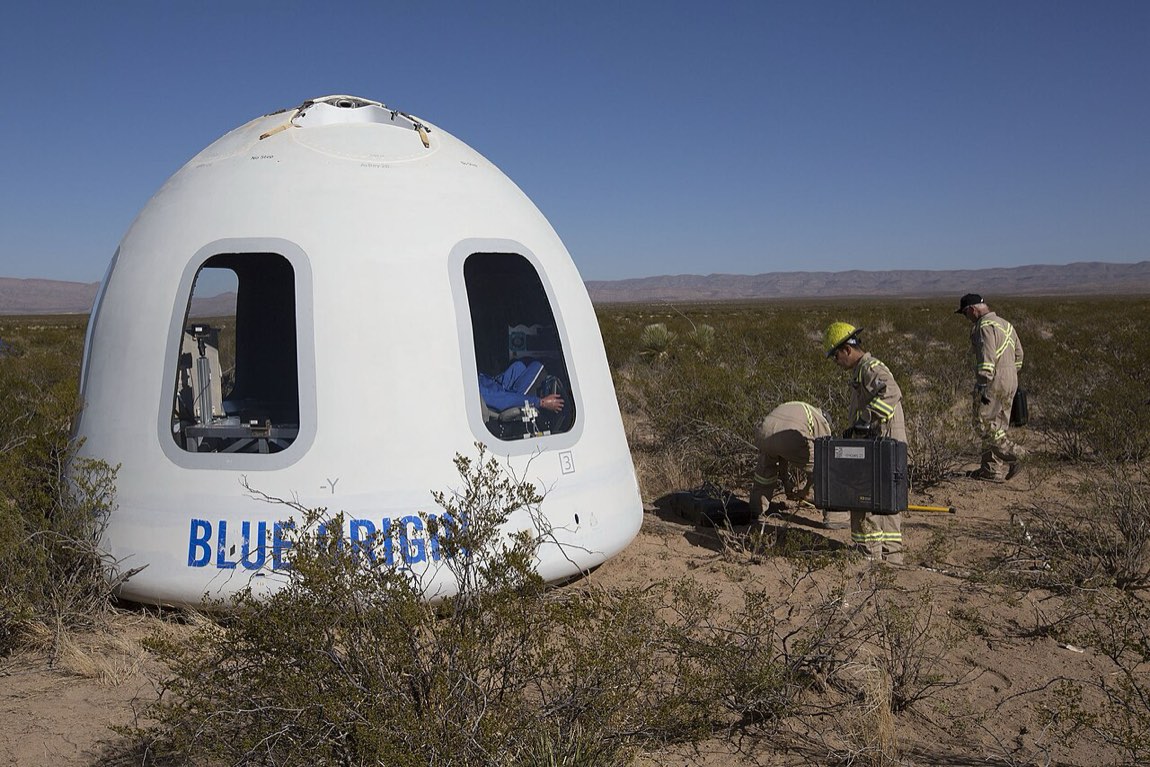
New Shepard is Blue Origin's suborbital vehicle, named after Alan Shepard, the first American to reach space. The rocket stands 19.2 meters (63 feet) tall, measures 3.8 meters (12 feet) in diameter, and has a launch mass of 75 short tons. Its crew capsule can carry up to six passengers, cargo, or a combination of both. A single BE-3PM engine, producing 490 kN of thrust at liftoff, drives the booster to an apogee of 100.5 kilometers — just above the Kármán line — where occupants experience a few minutes of weightlessness. The capsule then separates, returns through the atmosphere, and touches down under three parachutes assisted by a solid rocket motor for a soft landing. The booster, meanwhile, performs a powered vertical descent back to the same launch pad it left from. The BE-3PM engine can throttle down to as low as 110 kN specifically to enable the precision needed for that controlled landing. As of early 2025, New Shepard had flown 31 times overall, with 26 successful booster recoveries, one partial failure deemed successful, and one outright failure.
 ⤢
⤢
05 First Crewed Flight and the NS-16 Mission
On July 20, 2021 — the 52nd anniversary of the Apollo 11 Moon landing — New Shepard flew its first crewed mission, designated NS-16. The flight lasted approximately 10 minutes and carried four passengers across the Kármán line. Jeff Bezos flew alongside his brother Mark Bezos, aviation pioneer Wally Funk, and Oliver Daemen. A fifth seat had been won at auction for an undisclosed sum by a winner who later dropped out due to a scheduling conflict; that person was subsequently revealed to be Justin Sun. The flight was notable partly because Wally Funk, who had trained as an astronaut in the 1960s but never flown to space, became one of the oldest people to reach space at the time. Subsequent crewed and cargo missions continued under the designations NS-17 through NS-23. By February 25, 2025, Blue Origin had completed its tenth human spaceflight mission — a tourism flight carrying six paying passengers — and its 30th overall New Shepard flight. The 11th human spaceflight, completed on April 14, 2025, carried an all-female crew of six.
06 New Glenn and the Road to Orbit
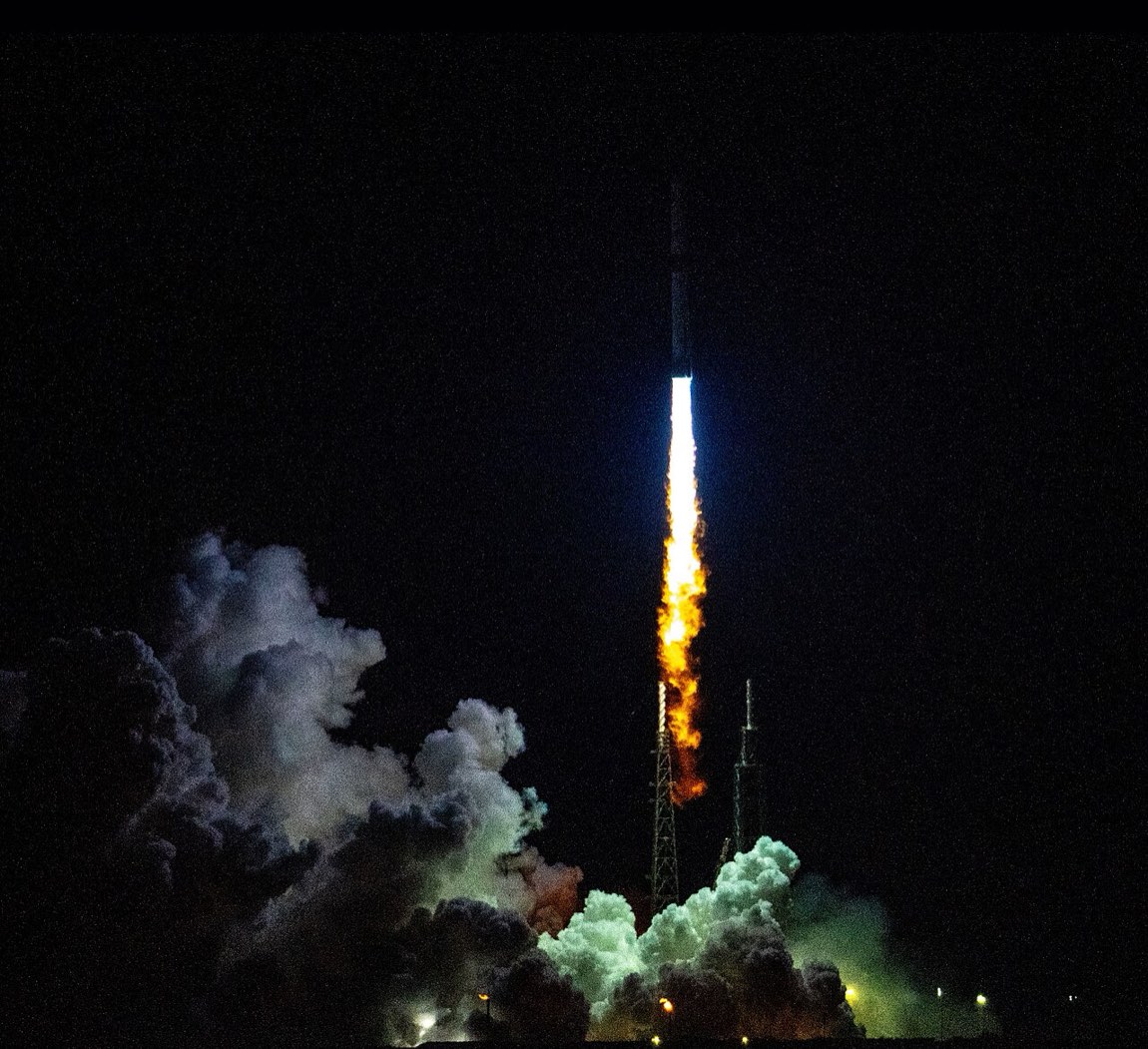
New Glenn represents Blue Origin's leap from suborbital tourism to genuine orbital launch capability. Named after astronaut John Glenn, the heavy-lift rocket has a 7-meter (23-foot) diameter first stage powered by seven BE-4 engines. Its first stage is designed to be reusable, and by 2021 the company had begun conceptual work — under the internal codename Project Jarvis — on potentially making the second stage reusable as well. The rocket's fairing is claimed to offer twice the payload volume of any commercial launch system, described as the largest payload fairing in the world. Design work began in early 2012, but the vehicle's existence was not publicly acknowledged until September 2015, with its name and high-level specifications released in September 2016. The full rocket was first unveiled on a launch pad on February 21, 2024. After years of delays, New Glenn achieved its first successful orbital launch on January 16, 2025, from Launch Complex 36 at Cape Canaveral Space Force Station. The primary payload was the Blue Ring Pathfinder test satellite, which was successfully placed into orbit. A three-stage variant of the rocket is also possible, in addition to the standard two-stage configuration.
 ⤢
⤢
07 The BE-4 Engine and the ULA Partnership Deeper
Blue Origin's entry into the orbital engine business began in 2011, when development of the BE-4 engine started. In late 2014 the company signed a formal agreement with United Launch Alliance to supply BE-4 engines for ULA's Vulcan Centaur rocket, replacing the Russian-made RD-180. The BE-4 burns liquid oxygen and liquified natural gas, producing 2,400 kN (550,000 lbf) of thrust — each Vulcan Centaur first stage uses two of them. Delivering flight-ready engines proved to be a long process. In October 2022, Blue Origin announced that the first two BE-4 engines had been delivered and were being integrated onto a Vulcan booster. On June 7, 2023, a Flight Readiness Firing at Cape Canaveral's launch pad 41 confirmed both engines performed as expected. Vulcan Centaur finally launched for the first time on January 8, 2024, carrying Astrobotic Technology's Peregrine lunar lander on NASA's Commercial Lunar Payload Services program. For Blue Origin the engine supply relationship represented a significant and durable revenue stream independent of its own launch operations, with the CEO noting "hundreds of millions in revenue" and "billions of dollars in orders" by 2023.
08 The May 2026 Explosion and Its Aftermath
Blue Origin's most serious setback came on May 28, 2026, during a static fire test of New Glenn at Launch Complex 36. A catastrophic explosion occurred that industry experts described as generating the largest explosion in launch vehicle history since the Soviet N1 rocket disaster in 1969. The blast destroyed or severely damaged critical infrastructure at LC-36, including the lightning tower, the transporter-erector, and hydraulic cylinders. In August 2026, Blue Origin announced that its investigation had traced the failure to the main oxygen valve on one of the BE-4 engines. The company said component-level testing had confirmed the finding and that modified valve hardware was already being manufactured. Rather than rebuild LC-36 in its original configuration, Blue Origin announced in June 2026 that it would modify the complex — preserving infrastructure that remained usable while redesigning damaged elements. In July 2026, NASA and Blue Origin agreed to conduct second-stage hot-fire testing for New Glenn at NASA's B-2 test stand at Stennis Space Center in Mississippi, keeping development of both the vehicle and Artemis-related work moving during the recovery period.
 ⤢
⤢
09 Blue Moon and the $3.4 Billion Artemis Bet
Blue Origin's lunar ambitions crystallized publicly in May 2019 when Jeff Bezos unveiled Blue Moon, a crew-capable lunar lander powered by the BE-7 hydrolox engine. The BE-7 is a dual expander cycle engine producing 44 kN (10,000 lbf) of thrust, with ignition tests beginning in June 2019 and thrust chamber testing continuing through 2023. The lander's standard configuration can carry up to 3,600 kilograms (7,900 lb) to the lunar surface; a stretched-tank variant can carry up to 6,500 kilograms (14,300 lb). Blue Origin first competed for NASA's Human Landing System contract in 2020, leading a "National Team" that included Lockheed Martin, Northrop Grumman, and Draper. When NASA awarded that contract to SpaceX in April 2021, Blue Origin contested the decision. The challenge ultimately led NASA to fund a second Human Landing System provider. On May 19, 2023, NASA contracted Blue Origin for $3.4 billion to develop, test, and fly Blue Moon for the Artemis V mission, with an uncrewed test flight followed by a crewed Moon landing planned for 2029. By mid-2024, the company had completed initial acceptance testing on the thrusters for the MK1 variant of the lander.
10 Engine Lineage: From BE-1 to BE-7 Deeper
Blue Origin has developed a family of rocket engines that spans an enormous range of capability and propellant chemistry. The BE-1, the company's first engine, burned hydrogen peroxide as a single propellant and produced just 8.9 kN (2,000 lbf) of thrust — enough to power the early Goddard test vehicle. The BE-2 stepped up to a bipropellant design using kerosene and peroxide, producing 140 kN (31,000 lbf), and powered five engines on the PM2 test vehicle. The BE-3 family, fueled by liquid hydrogen and liquid oxygen, comes in two variants: the BE-3PM used in New Shepard's booster produces 490 kN and can throttle down to 110 kN for precision landings, while the BE-3U, used in New Glenn's second stage, produces 710 kN. By December 2013, the BE-3 had logged more than 160 starts and 9,100 seconds — roughly 2.5 hours — of total operation at the Van Horn test facility. The BE-4, burning liquid oxygen and liquified natural gas at 2,400 kN, powers both New Glenn's first stage and ULA's Vulcan Centaur. The BE-7, designed for Blue Moon, produces 44 kN and uses a dual expander cycle, an architecture chosen to maximize reliability in the demanding lunar landing environment.
11 Facilities: Where Blue Origin Builds and Tests
Blue Origin operates across five main facilities and five field offices spread throughout the United States. Its headquarters and primary rocket development site is in Kent, Washington, where the company has expanded steadily since 2016, adding an adjacent 11,000-square-meter (120,000-square-foot) building and filing permits for a 21,900-square-meter (236,000-square-foot) warehouse complex. A new headquarters and R&D facility called the O'Neill Building opened on June 6, 2020. Engine manufacturing takes place at a 600,000-square-foot (56,000-square-meter) facility in Huntsville, Alabama — marketed as "Blue Engine" and located in what the company calls "The Rocket City" — which handles high-rate production of the BE-4 and BE-3U. Launch Site One in Van Horn, Texas, hosts the New Shepard launch and landing pads along with test stands for BE-3 and BE-4 engines capable of full-thrust, full-duration burns. At Cape Canaveral Space Force Station, Blue Origin converted Launch Complex 36 — assembled from the former LC-11, LC-12, LC-36A, and LC-36B land parcels, totaling 306 acres — into its orbital launch site. Large vehicle components such as New Glenn's stages and fairings are manufactured at nearby Exploration Park on Merritt Island, Florida.
12 Beyond Launch: Blue Ring, TeraWave, and Project Sunrise
Blue Origin is developing several ventures that extend well beyond rockets. The Blue Ring spacecraft, announced in October 2023, is an in-space logistics and delivery platform with its own engine, intended to handle orbital transfer and servicing tasks; its capabilities are being tested through a partnership with the United States Space Force on a mission called DarkSky-1. In January 2026, the company announced TeraWave, a proposed communications constellation comprising more than 5,000 satellites in low Earth orbit and 128 free-space optical communication satellites in medium Earth orbit, promising multi-terabit-per-second interlinks and 144-gigabit-per-second ground data rates. In March 2026, Blue Origin took an even more speculative step, filing a request to deploy a constellation of 51,600 satellites to form what it described as an orbital artificial intelligence data center system, called Project Sunrise. The company is also pursuing nuclear propulsion through two separate programs: a $2.9 million DARPA contract under the DRACO program to develop nuclear spacecraft component designs, and a partnership in a team that won a $5 million NASA and Department of Energy contract to develop the PADME long-range nuclear propulsion system intended for Mars missions.
13 Orbital Reef and the Commercial Station Race
With the International Space Station scheduled to be retired, NASA is funding private successors, and Blue Origin is competing for that market through Orbital Reef. The project, developed in partnership with Sierra Space, Boeing, Redwire Space, and Genesis Engineering Solutions, won a $130 million NASA award to begin design work, with NASA increasing that funding by an additional $42 million in 2024 for a cumulative total of $172 million. Orbital Reef is envisioned as a modular commercial space station in low Earth orbit, functioning as an expandable business park for tourism, scientific research, and in-space manufacturing. The design prioritizes compatibility: it is intended to accept docking from nearly every spacecraft currently in operation, including SpaceX Dragon 2, Soyuz, Dream Chaser, and Boeing Starliner. The initial modules planned are designated Life, Node, Core, and Research. Boeing's Starliner and Sierra Space's Dream Chaser are identified as the primary crew transport vehicles. The project reflects Blue Origin's broader strategy of building not just rockets but the full infrastructure of a sustained human presence in space — a long-term goal that Jeff Bezos has described as moving heavy industry off Earth entirely.