Axiom Space
Company · United States · founded 2016
The company building the ISS's heir: Axiom flies private and national-agency astronauts to the station today and is constructing commercial modules to attach to it — designed to separate into an independent station before the ISS retires. It also won the contract for Artemis moonwalk suits.
✦ Highlights
- First all-private ISS mission (2022)
- Commercial station modules
- Artemis spacesuits
The deep dive
Researched for the Atlas from Wikipedia — Axiom Space (18,125 characters read) · updated Sep 20, 2026
01 Two Founders, One NASA Pedigree
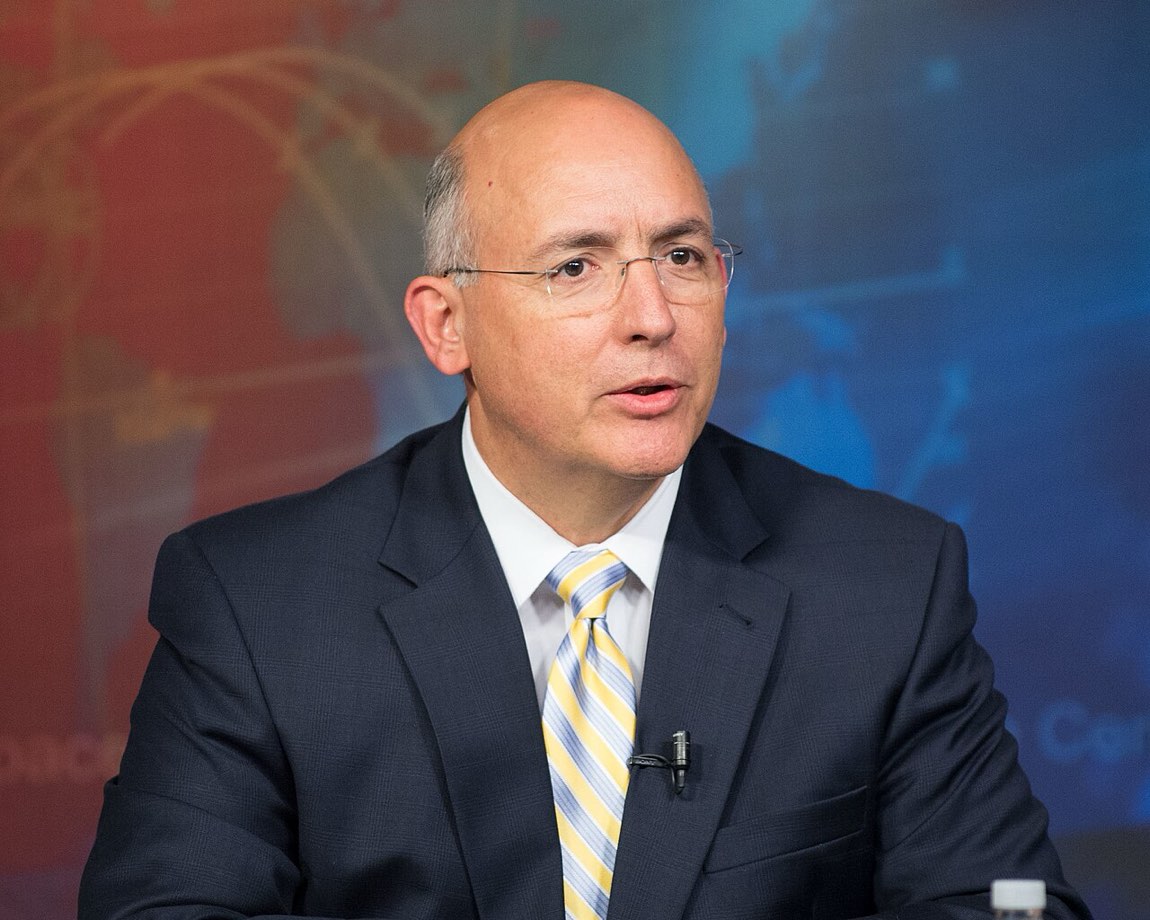
Axiom Space grew directly out of decades of NASA institutional knowledge. Michael T. Suffredini served as NASA's program manager for the International Space Station from 2005 to 2015 — a decade overseeing the most complex continuously crewed structure ever built. After retiring, he partnered with Kam Ghaffarian, an engineer and entrepreneur whose company Stinger Ghaffarian Technologies had grown into a large NASA contractor before being sold to KBR in 2018. Ghaffarian also chairs Quantum Space, reflecting a broader bet on the commercial space economy. The two founded Axiom Space in 2016 specifically to capture what Suffredini had watched emerge from inside NASA: a nascent market for private access to low Earth orbit. By February 2021 the company had reached 110 employees with offices in Houston and Los Angeles, and by December 2025 it had attracted a $100 million equity investment from Hungarian telecommunications firm 4iG Group, structured in two tranches through March 2026, making 4iG the company's anchor investor.
02 The NASA Contract That Started Everything
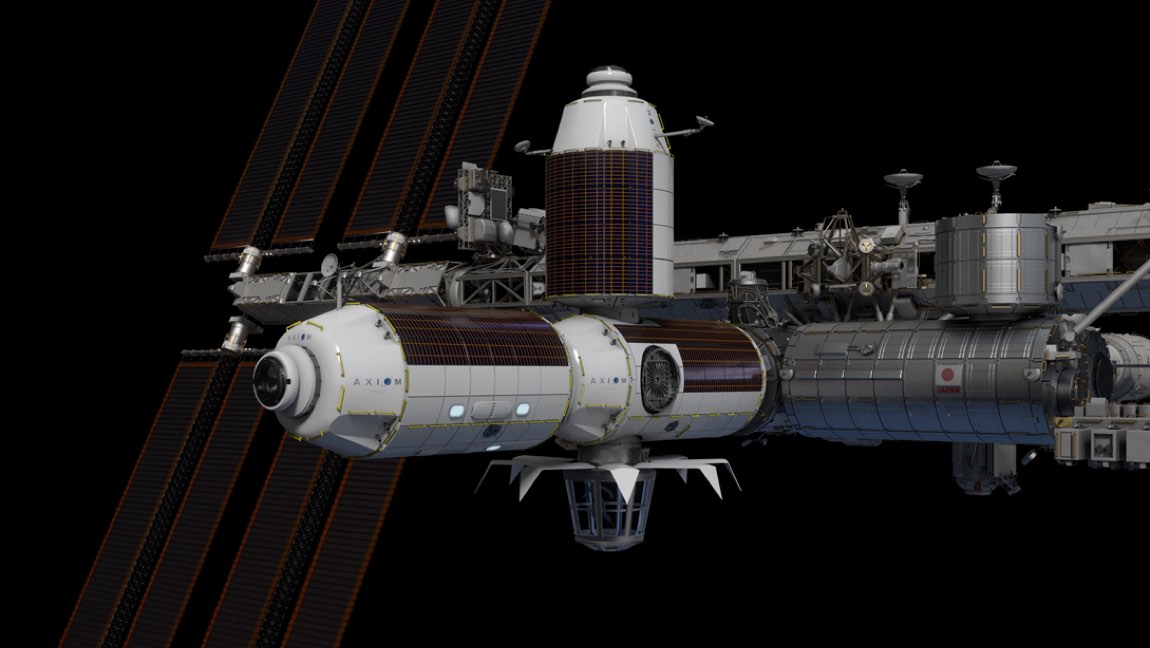
In 2020, under NASA's Next Space Technologies for Exploration Partnerships — a cislunar initiative known as NextSTEP — NASA awarded Axiom Space a contract worth US$140 million to provide at least one habitable spacecraft module to attach to the International Space Station. Notably, Axiom was the only company selected from that solicitation process; Bigelow Aerospace, a key potential competitor, did not submit a proposal and has since ceased operations entirely. The contract charged Axiom with commercializing services in the low Earth orbit economy from inside the ISS itself. The original January 2020 plan envisioned an "Axiom Segment" comprising four distinct elements: a node connector module, a research and manufacturing facility, a crew habitat, and a large-windowed Earth-viewing module. That architecture was later revised in December 2024, with only the first module — the Payload Power Thermal Module, or PPTM — required to dock with the ISS before separating in 2028 to join the second module, Hab-1, in a separate orbit.
 ⤢
⤢
03 Building a Station Before ISS Retires Deeper
The timeline Axiom is racing against is fixed: NASA plans to retire and deorbit the ISS in 2030. Axiom's strategy hinges on using the ISS as a construction anchor before that deadline closes. The PPTM is currently targeted for launch in 2027, docking to one of two ISS ports presently used for cargo spacecraft. Canadarm2, the iconic robotic arm of the ISS, may continue operations aboard Axiom Station after the ISS is retired. Following PPTM's separation from the ISS to rendezvous with Hab-1, the combined structure will function as an independent free-flying space station. As of December 2024, five modules are manifested on Axiom Station's assembly roadmap, with overall station completion targeted for the late 2020s to early 2030s. The company intends to keep at least one astronaut aboard continuously, responsible for research projects and station repairs, supported by amenities including high-speed Wi-Fi, video screens, picture windows, and a glass-walled cupola.
04 Philippe Starck Designs a Space Habitat
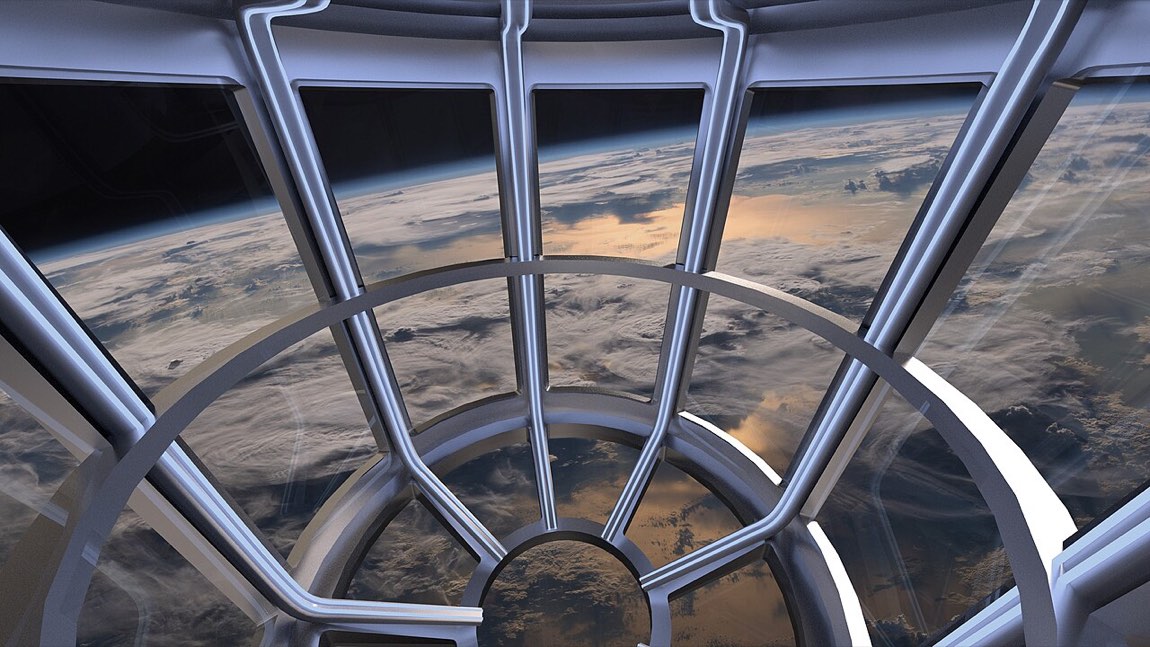
The interior of Axiom Station was designed in 2018 by French architect Philippe Starck, best known for luxury hotels and consumer products on the ground. The challenge of designing for microgravity — where there is no floor, ceiling, or consistent up — produced something visually striking. Renderings show chambers whose walls are entirely covered in tufted padding, studded with hundreds of color-changing LEDs that can shift the ambiance of the habitat. The design reflects a deliberate philosophy: Axiom is selling spaceflight not just to government agencies but to private individuals and corporations who expect a certain standard of environment. Alongside the Starck aesthetic, the station is planned to include picture windows and a glass-walled cupola for Earth observation — echoing the ISS Cupola that became one of the most photographed spaces in orbit — while practical infrastructure like high-speed Wi-Fi and video screens underlines that this is meant to be a working commercial facility, not purely a scientific outpost.
 ⤢
⤢
05 Four Private Missions, Four National Firsts
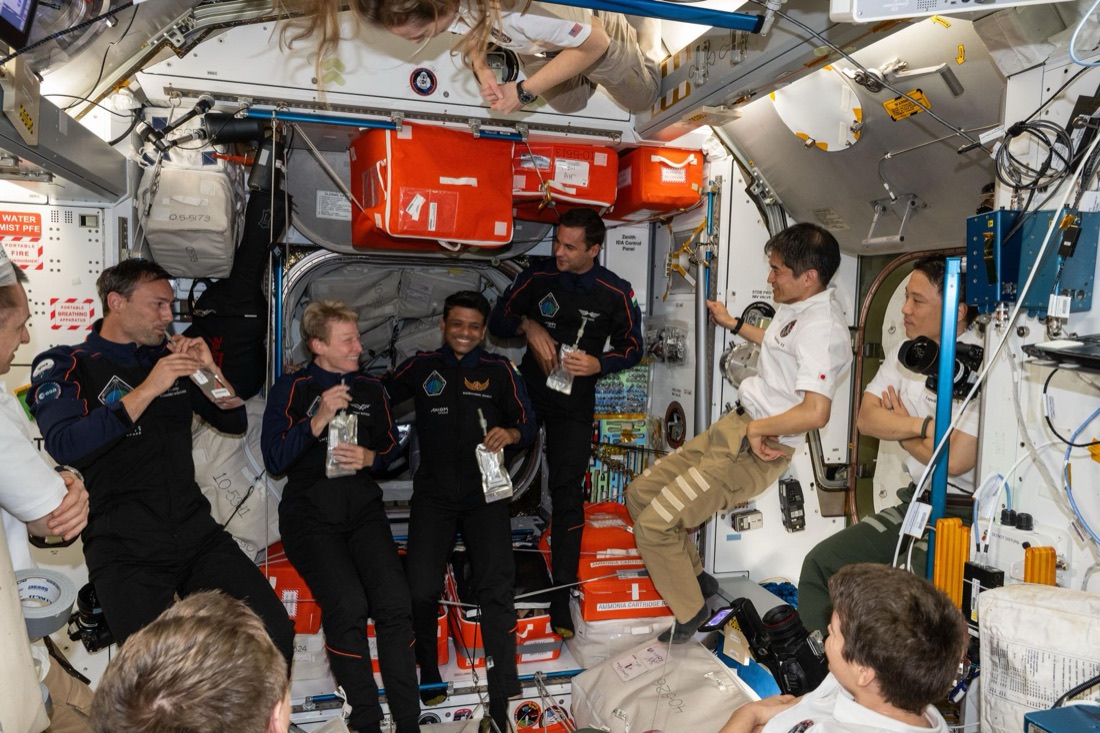
Axiom's crewed missions to the ISS have consistently been vehicles for national spaceflight milestones. Ax-2, which launched May 21, 2023, carried Saudi Arabia's Rayyanah Barnawi and Ali Alqarni — the first Saudi woman and second Saudi man in space — commanded by former NASA astronaut Peggy Whitson. Ax-3, launched January 18, 2024, took Alper Gezeravcı of Turkey and Marcus Wandt of Sweden to the ISS, with Italian Air Force Colonel Walter Villadei as pilot and Michael López-Alegría as commander. Ax-4, launched June 25, 2025, carried India's Shubhanshu Shukla as mission pilot — part of his training for the Gaganyaan crewed mission — alongside Poland's Sławosz Uznański-Wiśniewski and Hungary's Tibor Kapu as mission specialists, with Peggy Whitson again in command. Ax-5 is planned for no earlier than January 2027. In each case, memoranda of understanding signed months or years in advance laid the diplomatic and commercial groundwork for each nation's astronaut seat.
06 Mission Control: Axiom's Own Flight Center Deeper
Running crewed ISS missions requires more than a rocket and a crew — it requires a certified ground control infrastructure. Axiom's Mission Control Center, designated MCC-A and located at company headquarters in Houston, completed its first on-orbit science payload operation in January 2022. By April 2022, MCC-A was supporting Ax-1 and set a record for the number of on-orbit science payload operations and live on-orbit events handled during a single mission. By late 2022, MCC-A had achieved formal certification as an ISS partner Mission Control Center, connected to NASA's ISS program and joining a small handful of international partner MCCs alongside SpaceX's own facility. For Ax-2 in May 2023, MCC-A ran the entire mission with an Axiom Space flight control team of just 6 to 10 flight controllers — a lean operation compared to the hundreds involved in traditional government mission control, reflecting the efficiency model Axiom is building toward for commercial station operations.
 ⤢
⤢
07 The Spacesuit Gamble and Its Delays Deeper
On June 1, 2022, NASA selected Axiom Space to develop next-generation spacesuits and spacewalk systems for use outside the ISS, on the lunar surface for Artemis missions, and eventually for human missions to Mars. Collins Aerospace received a parallel contract for ISS-focused suits, and in July 2023 both companies received additional contracts to develop variants of their suits for the other environment. That competitive arrangement collapsed by June 24, 2024, when Collins descoped its lunar development contract — despite having tested a working prototype in microgravity — to focus instead on maintaining existing ISS suits, leaving Axiom as the sole developer of new suits for both environments. The pressure mounted further: at the 41st Space Symposium on April 13, 2026, Axiom stated it planned to fly a suit prototype to space in 2027, but just three days later NASA's Office of Inspector General warned that even with schedule acceleration there is "little to no schedule margin" for suits to be ready for the Artemis lunar landing, with delivery not expected until 2031.
08 A Web of International Partnerships
Axiom's business model is inseparable from its diplomatic reach. The company has signed memoranda of understanding with space agencies or government bodies in Argentina, Canada, the Czech Republic, Egypt, Ghana, Hungary, India, Israel, Italy, Mexico, New Zealand, Poland, Portugal, Saudi Arabia, Senegal, Slovakia, Turkey, the United Arab Emirates, and the United Kingdom, among others. These agreements typically bundle astronaut seats on upcoming Axiom missions with longer-term commitments to Axiom Station access, microgravity research, and technology development. The UK deal is particularly unusual: rather than a mission to the ISS, Axiom and the UK Space Agency agreed to pursue a standalone two-week crewed mission to low Earth orbit carrying a crew of four to perform scientific research, technology demonstrations, and education outreach — essentially a private orbital expedition with no station involved. British ESA astronaut Tim Peake was hired as a commercial Axiom astronaut in July 2024 in connection with that effort.
 ⤢
⤢
09 The UAE Seat That Changed Hands
Not every Axiom partnership has unfolded as planned. On April 29, 2022, Axiom signed a memorandum of understanding with the Mohammed bin Rashid Space Centre to fly an Emirati astronaut on a future Axiom mission, positioned as a follow-up to Hazza Al Mansouri's 2019 Soyuz flight. However, no UAE astronaut ultimately flew on an Axiom mission. Instead, Axiom purchased a seat on Soyuz MS-18 for NASA astronaut Mark T. Vande Hei so that Sultan Al Neyadi could take Vande Hei's spot on SpaceX Crew-6 — a logistical swap that achieved the UAE's objective of getting their astronaut to the ISS without going through an Axiom mission at all. The episode illustrates the complex, fluid nature of commercial seat trading in the current era, where the goal of a nation reaching orbit can be accomplished through multiple competing and cooperating operators simultaneously.
10 Human Spaceflight as a Packaged Service
Axiom frames its ISS missions not simply as transportation but as end-to-end mission services. A standard 10-day ISS mission comes packaged with 15 weeks of preflight training. Beyond training, the company states that packages include mission planning, hardware development, life support, medical support, crew provisions, hardware and safety certifications, on-orbit operations, and full mission management — effectively absorbing all the functions that a national space agency would traditionally handle in-house. Missions can extend beyond 10 days depending on the research or commercial focus involved. Former NASA astronauts Peggy Whitson and Michael López-Alegría serve as employees and mission commanders, lending institutional credibility to the commercial product. The company also has plans for in-space research and manufacturing, using the ISS National Lab until its own modules become operational, targeting microgravity as a production and research environment unavailable anywhere on Earth.
11 Italy's Module and the PPTM Connection Deeper
The Payload Power Thermal Module — Axiom's first station module and the one scheduled to dock to the ISS in 2027 — has a specific national origin story. On May 25, 2022, Axiom signed a memorandum of understanding with Italian Minister Vittorio Colao for technological innovation, centered on the development of space infrastructure and explicitly including an Italian Module for Axiom Station, which later became the PPTM. Italy's involvement goes beyond hardware: Italian Air Force Colonel Walter Villadei flew as pilot on Ax-3, launched January 18, 2024, deepening the operational relationship. The 4iG Group's $100 million investment from Hungary, finalized in December 2025, adds another national-commercial layer, with the partnership explicitly tied to developing an Orbital Data Center for in-orbit data processing — a signal that Axiom Station is being positioned not just as a research outpost but as physical infrastructure for the space-based data economy.
12 Israel's Rakia Mission Within Axiom-1
Axiom Mission 1, which launched April 8, 2022 and returned April 25, 2022, carried Eytan Stibbe as part of what was independently branded the Rakia Mission — a collaboration involving the Ramon Foundation, the Israel Space Agency, the Israel Innovation Authority, and Israel's Ministry of Education. This structure illustrated something important about how Axiom's missions work in practice: the Axiom flight is the vehicle, but individual crew members can represent distinct national programs with their own institutional backers, branding, research agendas, and public engagement goals running in parallel. Stibbe's seat was not simply a ticket purchased by an individual but a coordinated national effort involving four separate Israeli institutions. This layered architecture — Axiom providing the transport and operations infrastructure while national programs run their own missions within it — has become a template repeated across subsequent Axiom flights.
13 What Comes After ISS: The Bigger Bet Deeper
Every element of Axiom's current business — ISS missions, the MCC-A, international MOUs, the spacesuit contract, the Italian module — is oriented toward a single wager: that when the ISS is deorbited in 2030, Axiom Station will be ready to serve as the successor commercial platform in low Earth orbit. The company's revised December 2024 assembly plan, requiring only PPTM to dock with the ISS before departing to join Hab-1, reflects an effort to reduce dependency on ISS schedule and port availability. With five modules manifested on the assembly roadmap and a target of late 2020s to early 2030s for completion, the timing is tight. The spacesuit delays flagged by NASA's Inspector General in April 2026 — delivery not expected until 2031 — add uncertainty about whether Axiom can meet Artemis commitments while simultaneously completing its station. NASA administrator Jared Isaacman's public statement that NASA is "reviewing where NASA can do better" signals that the agency is watching the schedule closely and is not treating Axiom's commitments as guaranteed.