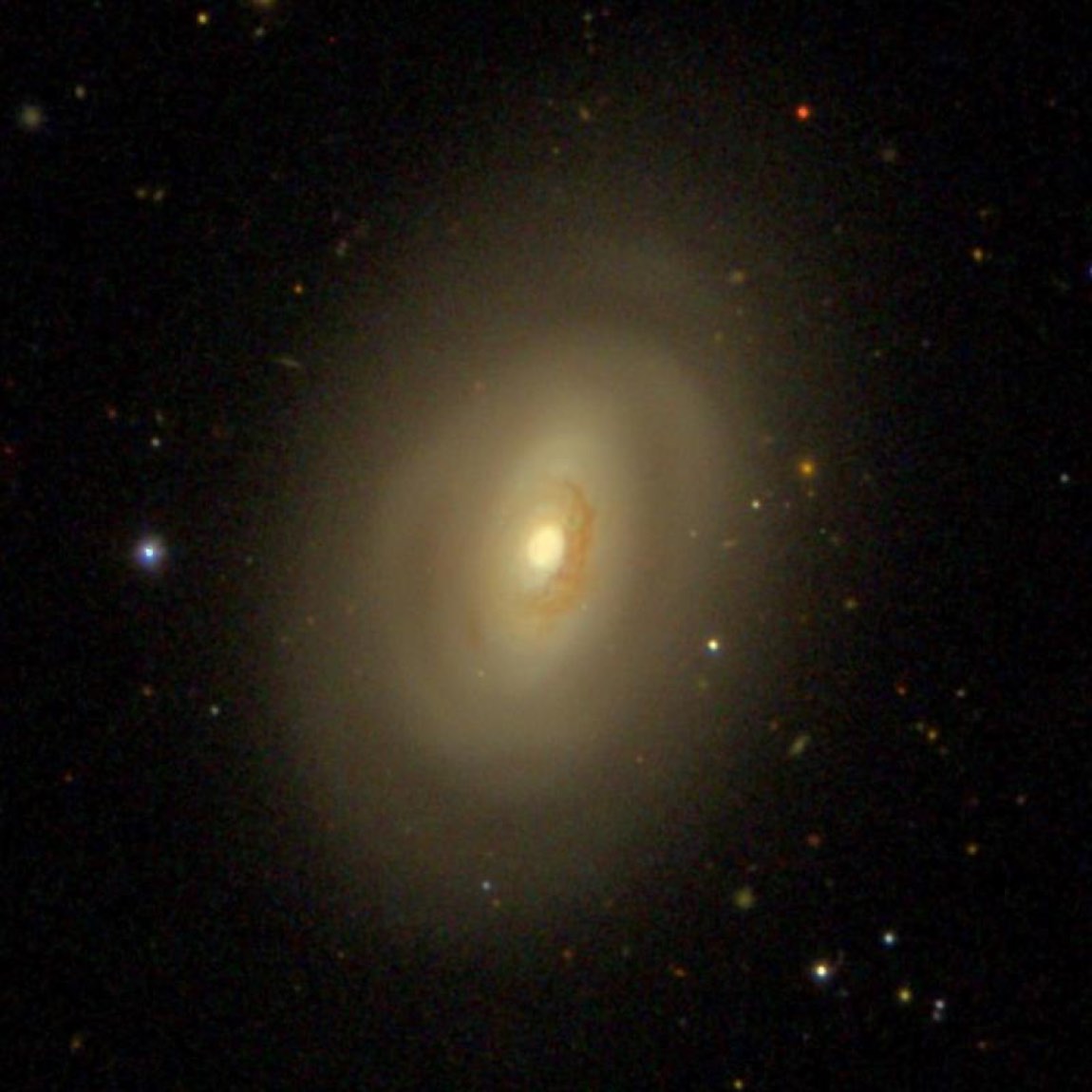
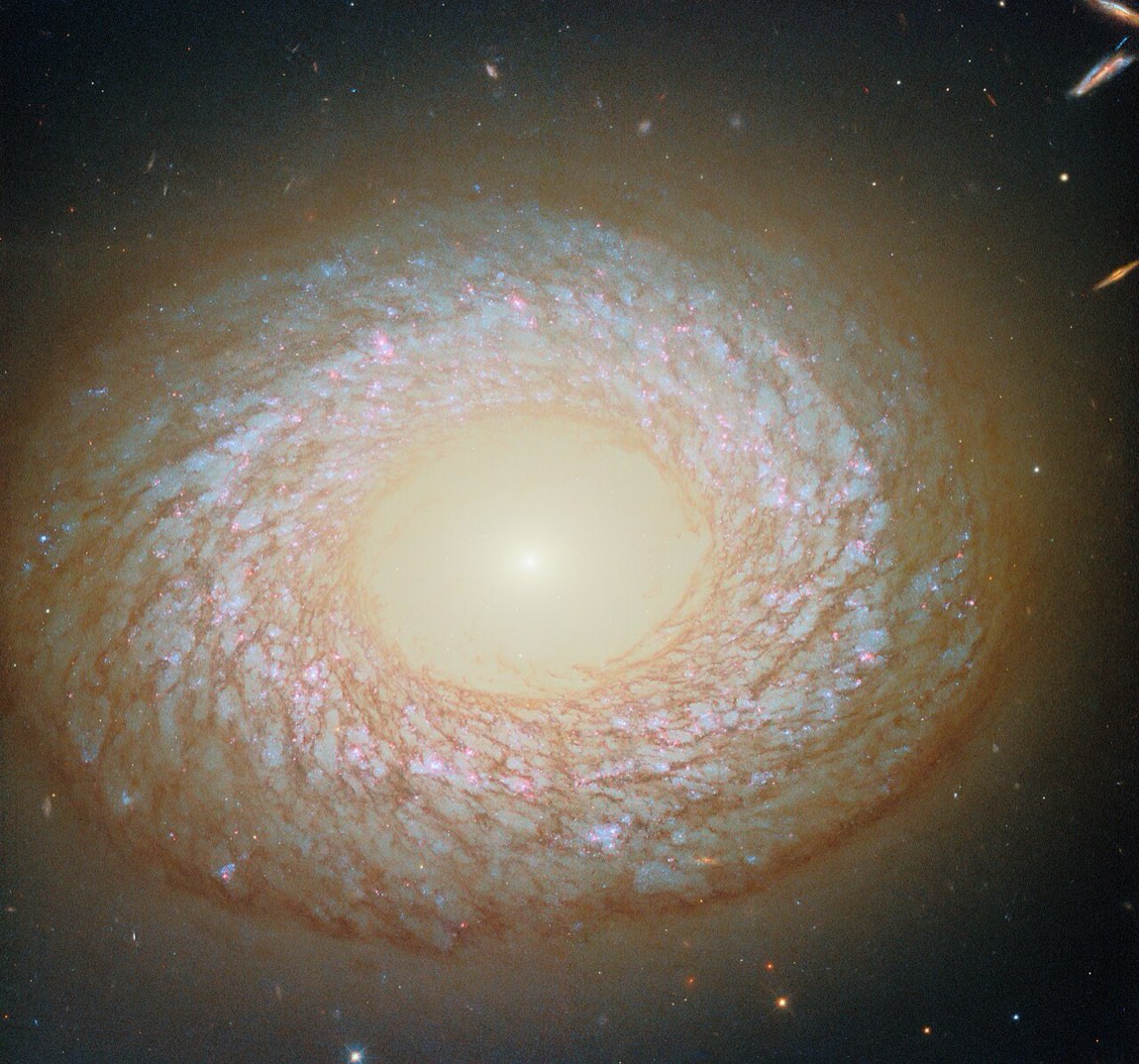
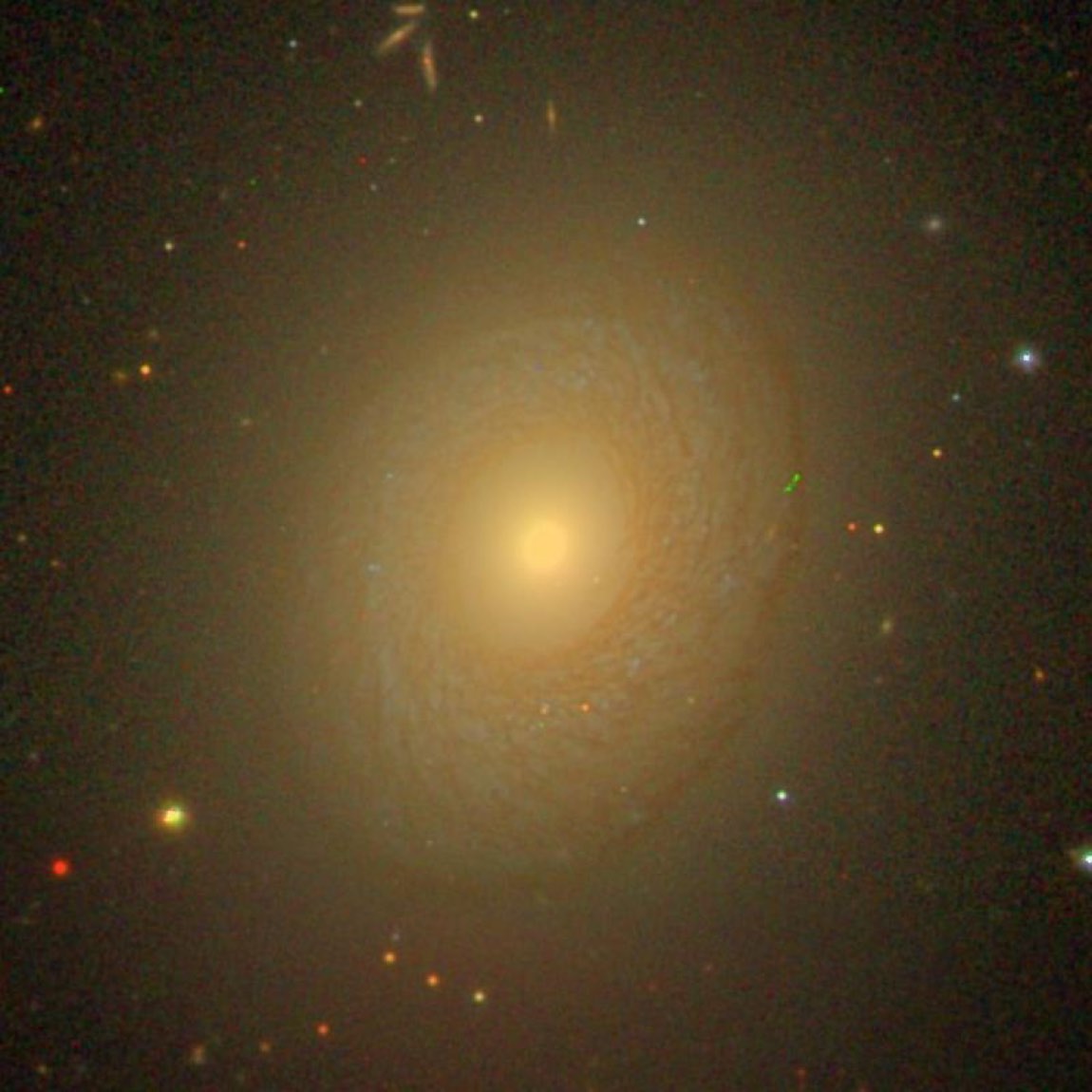
 Photograph · ESA/Hubble & NASA, F. Belfiore, J. Lee and the PHANGS-HST Team · CC BY 4.0
Galaxy · Deep guide
NGC 2775
Also called: Caldwell 48 · C48 · UGC 4820 · PGC 25861
A spiral with a huge, quiet bulge and a dusty star-forming ring around it.
What is it?
NGC 2775 is a spiral galaxy in Cancer, about 67 million light-years away. It has a large, gas-poor central bulge where almost no new stars form, surrounded by a dusty ring with tightly wound, patchy arms where star formation does go on. A tail of hydrogen gas and faint shell-like structures suggest a smaller companion galaxy has looped around it several times, losing mass as it went. It is the brightest member of the NGC 2775 Group. William Herschel discovered it on 19 December 1783.
The deep dive
Researched for the Atlas from Wikipedia — NGC 2775 (1,874 characters read) · updated Nov 15, 2026
01 A Galaxy Wearing a Double Identity
NGC 2775 carries two catalogue names with equal legitimacy. Astronomers know it as NGC 2775 from John Louis Emil Dreyer's New General Catalogue, but it also holds the designation Caldwell 48, a list compiled by amateur astronomer Patrick Moore as a practical observing guide to objects Messier left off his famous catalogue. Having a Caldwell number is a mark of observational accessibility — these are targets a dedicated amateur can actually find and appreciate through a backyard telescope. NGC 2775's inclusion on both lists reflects its status as a visually rewarding object: substantial enough to reward careful study, yet not so famous that it dominates popular astronomy coverage. William Herschel, the German-British astronomer who first recorded it on 19 December 1783, was methodically sweeping the sky at the time, and Cancer was a constellation he returned to repeatedly during his great survey campaigns of the 1780s.
02 What Those Classification Letters Actually Mean Deeper
The morphological code SA(r)ab packs a surprising amount of information into just a few characters. The opening SA signals an unbarred spiral — there is no elongated bar of stars cutting across the galactic centre, distinguishing it from the more common barred spirals designated SB. The parenthetical (r) flags a prominent ring structure, a band of material that encircles the nucleus and stands apart from the main disc. The closing letters ab describe how the spiral arms behave: they are flocculent and tightly wound, sitting between the loosely grand-design category and the most tightly coiled extreme. Flocculent arms are patchy and irregular rather than bold sweeping curves, often interpreted as evidence that local instabilities — rather than a single galaxy-wide density wave — are driving star formation in the disc. Together these features paint a picture of a galaxy with an unusually calm, gas-poor interior surrounded by a more active, dust-laden outer zone.
03 A Tilted View From Earth
We do not see NGC 2775 face-on. The galaxy is inclined by 44° to our line of sight, meaning we observe it at a moderate tilt — roughly the angle of a dinner plate propped at nearly half a right angle on a table. This inclination is significant for observers and researchers alike. Face-on galaxies reveal their spiral structure most clearly, while edge-on galaxies show their disc thickness and dust lanes in profile. NGC 2775 sits in between, offering a compromise view that lets astronomers trace both the ring structure around the nucleus and the extent of the spiral arms without either perspective being completely hidden. The tilt also affects how we measure the galaxy's internal motions through the Doppler shifting of spectral lines, since only the velocity component along our line of sight is directly measurable. Correcting for the 44° inclination is therefore a standard step in any analysis of how material moves within this galaxy.
04 The Quiet Core and Its Gas-Free Mystery Deeper
The nucleus of NGC 2775 is classified as not active — there is no quasar-like engine blazing at its centre, no jets of plasma shooting into intergalactic space. More striking still is how thoroughly gas-free the large nuclear bulge has become. The bulge extends out to an angular radius of 0.4 arcminutes from the centre, and throughout that region star formation is described as virtually absent. One compelling explanation offered for this gas depletion is a high historical supernova rate. When massive stars explode in rapid succession, the combined shock waves and energy injection can heat and expel interstellar gas from a region far more efficiently than any single event. If the central bulge once hosted intense star formation, a cascade of supernovae could have swept it clean of the raw material needed for new stars, effectively switching off the nucleus and leaving behind the passive, gas-poor structure we observe today.
 ⤢
05 Shells, Tails, and a Gravitational Mugging
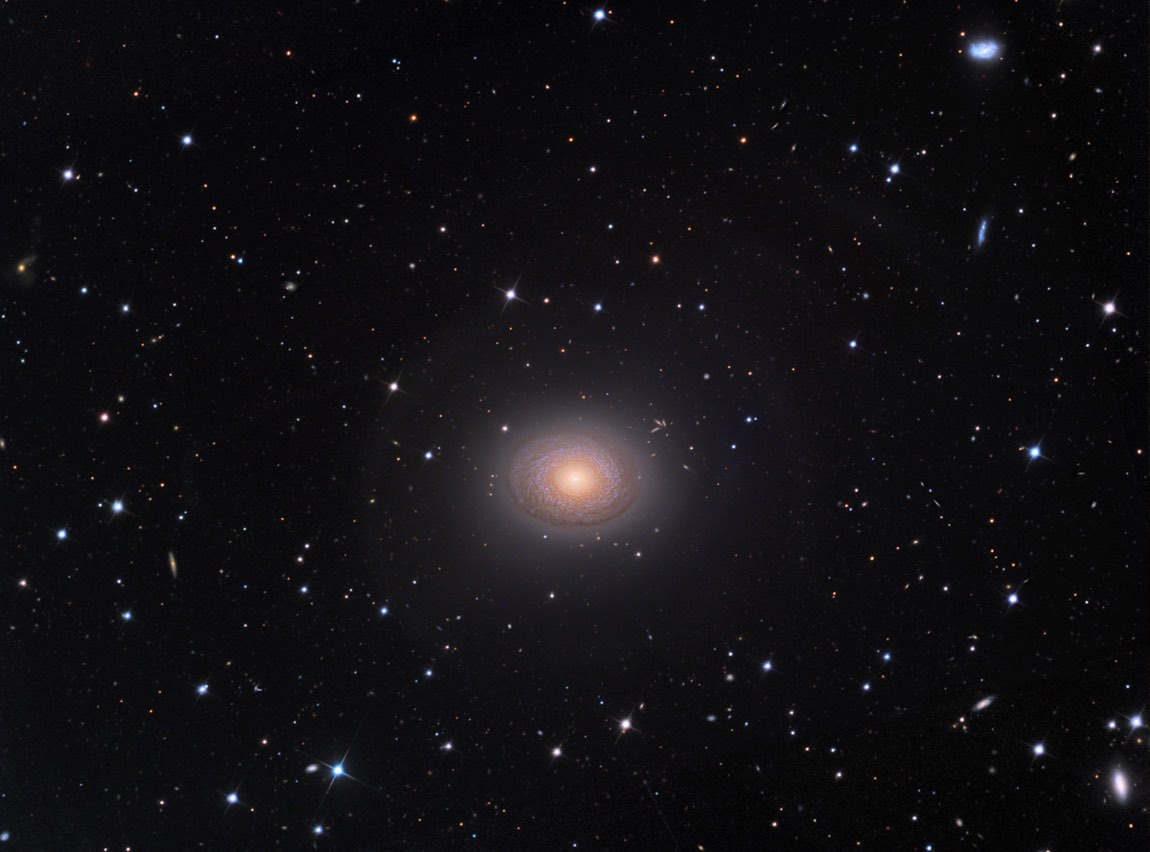
NGC 2775 wears the scars of a past gravitational encounter. A hydrogen tail feature detected around the galaxy points to an interaction with at least one faint companion. The likely culprit appears to have been a satellite galaxy that orbited NGC 2775 multiple times, gradually surrendering mass with each pass. This repeated stripping created faint shell-like structures — thin, arc-shaped overdensities of stars that wrap around the outer galaxy like ripples frozen in place. Shells are a recognised signature of minor mergers in astronomy: when a small galaxy is slowly dismantled by a larger one, its stars slosh back and forth within the host's gravitational well and pile up at the turning points of their orbits, forming those characteristic arcs. The whole picture suggests NGC 2775 has been quietly cannibalising a smaller neighbour over an extended period, adding mass to its outskirts while leaving its inner structure largely undisturbed.
06 NGC 2777 and the Hydrogen Bridge
The nearby irregular galaxy NGC 2777 is not simply a neighbour by coincidence of line-of-sight projection. It displays a tidal tail of hydrogen gas that points directly back toward NGC 2775, a physical signpost that the two galaxies have been gravitationally entangled. Tidal tails of neutral hydrogen form when a larger galaxy's gravity stretches and pulls material away from a smaller companion during a close approach. The fact that the tail is oriented toward NGC 2775 rather than randomly positioned is strong evidence that the two are genuinely interacting rather than merely appearing close in the sky. NGC 2777 is itself classified as an irregular galaxy, a morphological category that often signals a galaxy whose shape has been disrupted by external gravitational forces — consistent with the idea that repeated encounters with the much more massive NGC 2775 have stirred and distorted it over time. Both galaxies share membership in the NGC 2775 Group.
07 Star Birth at the Rim, Silence at the Centre Deeper
NGC 2775 presents an unusual inside-out picture of star formation. Active star birth is confined to the dusty outer ring identified in the galaxy's classification, while the nucleus is essentially sterile by comparison. Yet even with that ring activity, the galaxy does not qualify as a starburst — a phase in which star formation rates spike to extraordinary levels, often triggered by mergers or strong inflows of gas. NGC 2775 is forming stars, but at an ordinary, unhurried pace. This combination — a gas-poor, star-formation-free nucleus, a moderate ring of activity, and no overall starburst — places it in an interesting transitional category. It may represent a galaxy that experienced its peak of central star formation long ago, was swept clean by supernova feedback, and now sustains only a residual population of new stars at its outskirts where gas remains available. Understanding galaxies like NGC 2775 helps astronomers reconstruct how star formation migrates outward as a galaxy ages.
08 SN 1993Z: A Standard Candle Goes Off
On 23 September 1993, the Leuschner Observatory Supernova Search — known by the acronym LOSS — detected a supernova within NGC 2775 and designated it SN 1993Z. It was classified as a Type Ia event and reached an apparent magnitude of 13.9 at its brightest, making it quite luminous by supernova standards and observable with relatively modest equipment. By the time spectral analysis was completed around 25 September, astronomers determined that the explosion had actually peaked roughly four weeks earlier, meaning the discovery came after maximum light. Type Ia supernovae are especially prized in cosmology because they arise from a well-understood physical mechanism — the thermonuclear detonation of a white dwarf that has accreted enough mass to exceed a critical threshold — giving them a standardisable peak luminosity. This makes them powerful distance indicators. SN 1993Z is the only supernova so far recorded in NGC 2775, and its high supernova rate hypothesis for the nucleus rests in part on historical rather than directly observed events.
 ⤢
09 NGC 2775's Place in the Cosmic Neighbourhood
At 67 million light-years from the Milky Way, NGC 2775 is a mid-distance galaxy on cosmic scales — far enough that individual stars within it are unresolvable in most observations, but close enough for detailed structural studies. The galaxy is the dominant member of the NGC 2775 Group, also catalogued as LGG 169, which includes NGC 2777 and UGC 4781. This small group is itself embedded within the broader Antlia-Hydra Cluster of galaxies and sits inside the Virgo Supercluster — the same vast filamentary structure that contains our own Local Group. Superclusters are among the largest coherent structures in the universe, and membership in the Virgo Supercluster places NGC 2775 in the same cosmic web node as the Milky Way, though the two are separated by that 67-million-light-year gulf. As the most prominent member of its local group, NGC 2775 gravitationally dominates its immediate surroundings in much the same way the Milky Way dominates the Local Group.
10 Herschel's Night of Discovery
William Herschel logged NGC 2775 on 19 December 1783, during the period when he was conducting some of the most systematic sky surveys the world had yet seen. Herschel, born in Hanover but working in Britain, had already built himself a reputation for the discovery of Uranus in 1781 and was turning his hand-polished reflecting telescopes toward the deep sky with equal rigour. December 1783 was a productive month in his cataloguing work, and Cancer — a relatively faint constellation in the winter sky — yielded this spiral galaxy among other objects. At the time, the nature of such nebulae was entirely unknown; the distinction between gaseous nebulae within the Milky Way and external galaxies millions of light-years away would not be settled for another century and a half. Herschel recorded it as a nebulous object without any way of knowing he was looking at an entire galaxy of hundreds of billions of stars at an almost incomprehensible distance.
11 How and When to Observe NGC 2775
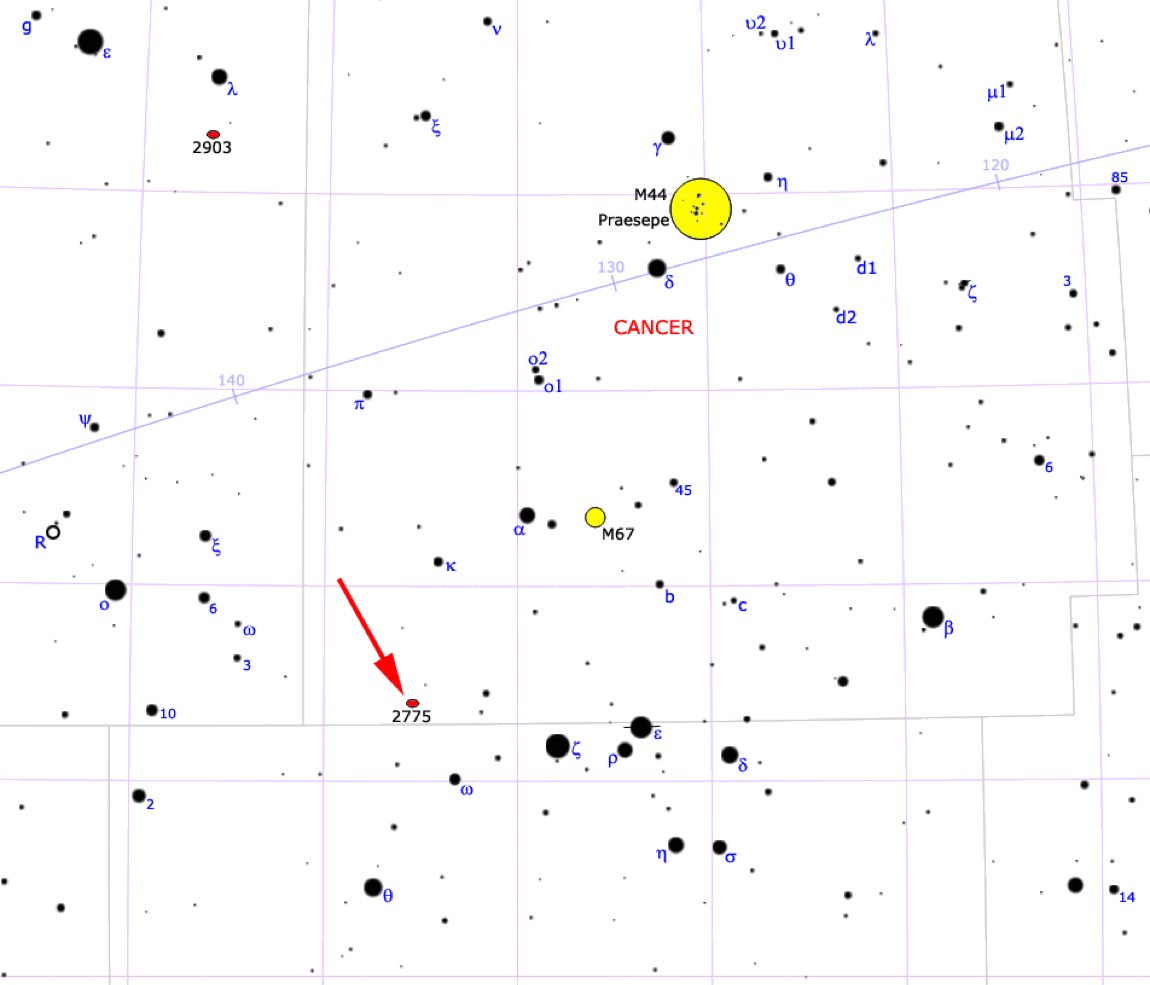
NGC 2775 sits in the constellation Cancer, which places it in the northern winter and spring evening sky for observers in the Northern Hemisphere. As Caldwell 48, it appears on observing lists aimed at ambitious amateur astronomers moving beyond the Messier catalogue. Its apparent magnitude makes it accessible through a moderate-aperture telescope under reasonably dark skies, though the faint shell structures and hydrogen tail features associated with its past interaction require professional instrumentation and long exposure imaging to detect. The galaxy's 44° inclination gives it an elongated appearance through the eyepiece rather than the round face-on disc that some galaxies present, which can help in orienting the view. Observers in Cancer can use the brighter stars of the constellation as stepping stones to locate it, and its membership in the NGC 2775 Group means that NGC 2777 may appear in the same wide field, offering a visual hint of the gravitational relationship that the hydrogen data reveals so clearly.
 ⤢